To part exchange a Rolex, you offer it to a retailer or dealer as part payment for another watch they sell. They inspect your watch, agree an allowance for it and you pay the balance. You give up some of what a private buyer might pay, in return for one transaction and no buyer to find. The figure to compare between dealers is the cash you hand over, not the allowance.
A part-exchange (or trade-in) is a sale and a purchase in one deal, with the two prices set against each other. An allowance is the sum the dealer credits for your watch. This guide is general information. It gives no prices, allowances or percentages for any watch.
How does it work when you part exchange a Rolex?
Most part-exchanges follow the same order: you describe the watch and get an estimate, the dealer inspects it, you get a firm figure, and the deal completes against the watch you are buying. The estimate is not an offer. The firm figure comes only after someone has handled the watch and checked its papers.
Watches of Switzerland, an Official Rolex Retailer group, sets out its own process as one example. Its pre-owned guide says the valuation is done in store while you wait, in about 5 to 15 minutes, based on make, model, age, condition and whether you have the original box and papers. It says the valuation price is fixed for 7 days, and that the part-exchange value can go towards any product in store, watches or jewellery, new or pre-owned (Watches of Switzerland, A guide to pre-owned, undated, checked 30 October 2026).
For a watch sent in rather than taken in, the same group’s sell page says the first quote is a ballpark estimate from your details and photos, with a firm offer after it receives the watch, typically within seven working days (Watches of Switzerland, sell my watch). Other businesses set their own steps, so ask before you travel or post the watch.
Where can you part exchange a Rolex in the UK?
Pre-owned specialists, independent dealers and some Official Rolex Retailer groups take watches in part-exchange. Watches of Switzerland says customers can discuss a part-exchange at any Watches of Switzerland, Mappin & Webb or Goldsmiths showroom. Policies differ by business and by stock, so ask whether a dealer takes a Rolex in against the watch you want.
If the watch you are buying is a Rolex Certified Pre-Owned watch, it comes with a two-year international guarantee from the date of purchase, a Certified Pre-Owned seal and a guarantee card (Watches of Switzerland, checked 30 October 2026). Any other dealer’s warranty is that dealer’s own promise. Our comparison of where to buy a pre-owned Rolex sets out the guarantee and return rights on each route.
How is a Rolex part-exchange allowance worked out?
A dealer starts from what it expects to resell your watch for, then takes off what it will spend before it can: inspection, any service or refinishing, the warranty it gives the next buyer, VAT on its margin, the cost of holding stock, and its own margin. Papers, condition, service history and demand for the reference all move the figure.
No dealer is obliged to publish how it calculates an allowance. Our guide to how dealers build an offer walks through each cost. For a Rolex, two things a dealer will look at closely are the guarantee card, which links the serial number to the first sale, and whether a service is due.
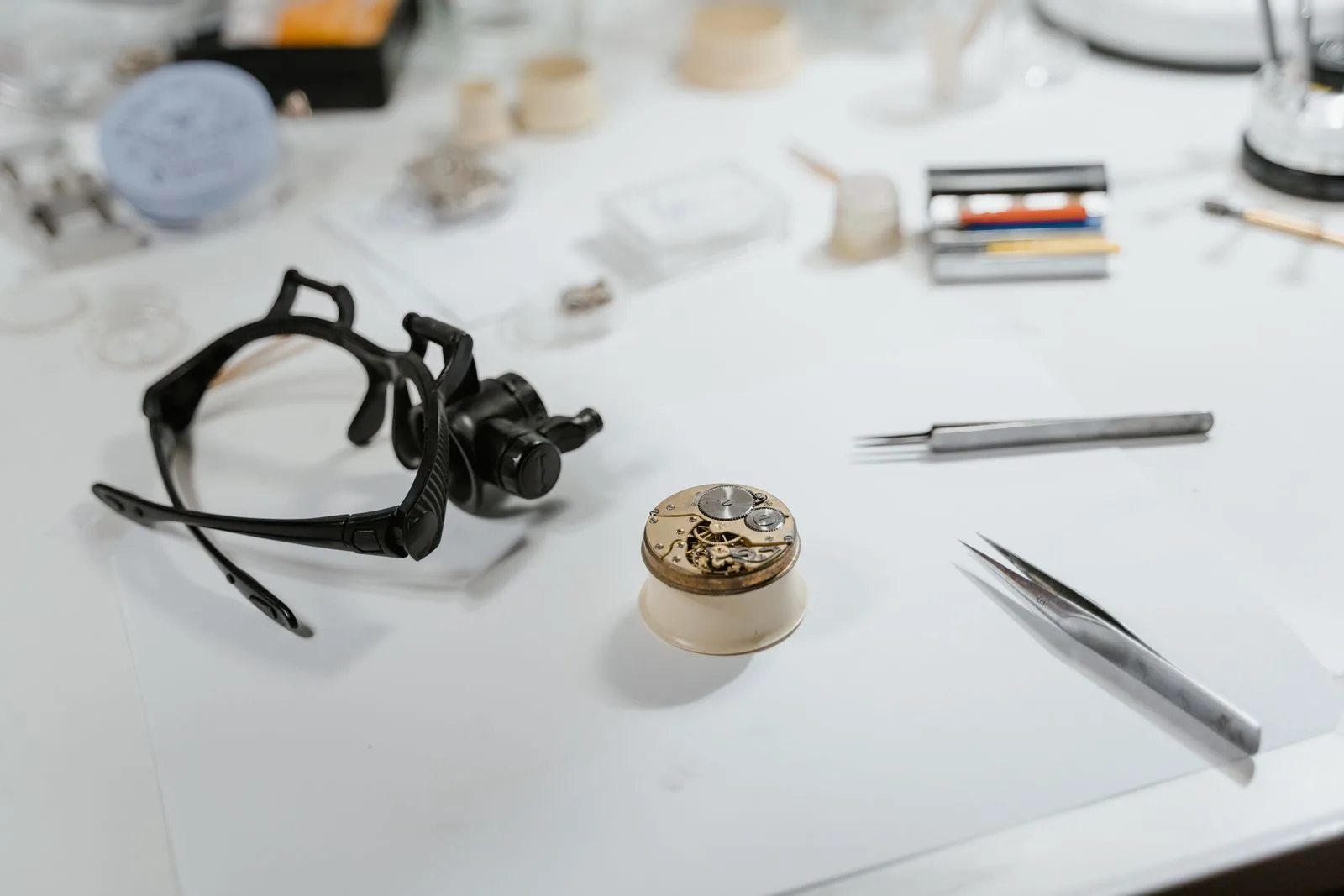
Servicing is a real cost in the calculation. Mappin & Webb says a Rolex service includes dismantling and cleaning the movement, replacing worn parts and refinishing the case and bracelet, and comes with a two-year international guarantee on parts and labour (Mappin & Webb, checked 30 October 2026). Recent service papers show the dealer that cost may not fall on it. Our guide to what servicing costs covers published brand prices.
How does the VAT margin scheme treat a part-exchange?
Many VAT-registered dealers sell second-hand watches under HMRC’s margin scheme, which taxes the difference between what the dealer paid for an item and what it sold it for, at 16.67% (one-sixth) of that difference. In a part-exchange, HMRC says the allowance counts as the dealer’s purchase price for your watch.
A margin scheme is an HMRC arrangement that lets a dealer charge VAT on its margin rather than on the full selling price. HMRC’s own example is an item bought for £1,500 and sold for £2,000: the margin is £500 and the VAT is £83.33 (GOV.UK, VAT margin schemes, checked 30 October 2026). That example is HMRC’s, not a watch price.
HMRC’s internal manual on part-exchange goods says that where the goods taken in are eligible for the margin scheme, “their purchase price is the full amount allowed for them”, and that the selling price of the goods the customer buys is the full amount charged (HMRC, VATMARG13350, updated 8 April 2026). In plain terms, the allowance becomes the dealer’s buying price for your Rolex, and the full ticket price of the watch you buy, not the balance you pay, is its selling price.
Illustrative example. To keep away from real prices, take an index where the dealer’s allowance on your watch is 60. If the dealer later resells your watch for 72, its margin is 12, and the VAT due under the margin scheme is one-sixth of that, 2. The dealer keeps 10 before its other costs: inspection, any service, the warranty it gives and the time the watch sits in stock. Raise the allowance to 66 and the margin on the same resale falls to 6, with VAT of 1, leaving 5. That is why a dealer’s allowance moves with its view of the resale figure and its costs, and why it rarely moves on its own.
Two practical points follow. A margin scheme invoice will not show VAT as a separate line: HMRC’s record-keeping guidance says “you must not show VAT separately”. And the same manual points dealers to separate HMRC guidance on part-exchange values inflated to obtain credit from finance companies. If you are paying the balance with finance, ask for the cash price and the allowance as separate figures; see Rolex finance in the UK.
This section is general information, not tax advice. VAT treatment depends on each business’s circumstances.
How do you compare two part-exchange deals?
Compare the cost to change: the price of the watch you are buying minus the allowance on yours. That is the cash you actually pay. A generous allowance against a full-price watch can leave you no better off than a smaller allowance and a discount, because the two halves of the deal move together.
| Figure to ask for | What it tells you | Why, and source |
|---|---|---|
| Price of the watch you are buying, before any allowance | Whether the watch itself is fairly priced | HMRC treats the full amount charged as the dealer’s selling price (VATMARG13350) |
| Allowance on your Rolex | What the dealer credits for your watch | HMRC treats the full amount allowed as the dealer’s purchase price (VATMARG13350) |
| Cost to change (price minus allowance) | The cash you pay to walk out with the new watch | The only figure that compares like with like between dealers |
| A straight cash offer for your Rolex | What the convenience of a part-exchange is costing you | A buy-in and a part-exchange can differ at the same dealer |
| How long the figure stands | Whether you have time to compare | Watches of Switzerland says its valuation price is fixed for 7 days (A guide to pre-owned) |
Sources: HMRC, VATMARG13350, part-exchange goods (updated 8 April 2026); Watches of Switzerland, a guide to pre-owned (undated). Checked 30 October 2026.
Illustrative example. Take an index where the ticket price of the watch you want at Dealer A is 100. Dealer A offers an allowance of 62 on your Rolex, so the cost to change is 38. Dealer B has the same model priced at 96 and offers an allowance of 57, so the cost to change is 39. Dealer A’s higher allowance looks better, and in this case it is, by 1; but Dealer B could close the gap with a small discount. Only the cost to change tells you which deal leaves more money in your pocket, and it assumes the two watches are comparable in condition, papers and warranty.
Get each figure in writing, from each dealer, for your watch described the same way. To push on the price of the watch you are buying, see negotiating on the new watch. If none of the deals suits you, selling separately is the other route; our guide to selling a Rolex in the UK covers what buyers ask for.

What is bumping, and why does it matter?
Bumping is HMRC’s name for raising the price of the item sold and the part-exchange allowance by matching amounts, so the balance stays the same. HMRC describes it in the car trade as dealers who “manipulate the value of part exchange vehicles” to meet a finance company’s requirements, such as minimum deposits, and says that as the seller “it is the dealer’s responsibility to ensure that the sale value is correctly accounted for” (HMRC, VATVAL06140, updated 15 June 2021). HMRC’s margin scheme manual on part-exchange goods points to that same guidance on inflated part-exchange values (VATMARG13350).
For you, the risk is on the credit application. If the paperwork sent to a lender shows a higher price and a higher allowance than you actually agreed, the figures you are signing are not true. If a dealer suggests showing different figures to a lender, decline, and ask for the real cash price and the real allowance on every document.
Can you part-exchange a Rolex by post?
Some businesses take watches in by post or courier, but the firm figure still waits until they have the watch in hand. Watches of Switzerland’s sell page says its first quote is a ballpark estimate from your details and photos, with a firm offer typically within seven working days of receiving the watch, and that a declined watch is returned to your nearest showroom at no extra cost (Watches of Switzerland, sell my watch, checked 30 October 2026).
If you post it yourself, match the cover to the value. Royal Mail Special Delivery Guaranteed covers up to £2,500 as standard, with a paid-for option up to £10,000 (Royal Mail, checked 30 October 2026), so a Rolex above that needs another carrier or the dealer’s own insured collection. Photograph the watch and its serial number before packing it, and ask who carries the risk while the watch is with the dealer. Our guide to how watches are shipped and insured compares the options.
What should you bring to a Rolex part-exchange?
Bring the guarantee card, box, booklets and receipt, any service cards and invoices, spare bracelet links and photo ID. A complete set answers the dealer’s questions before they are asked. Expect a careful business to check the watch is not recorded as stolen and that it is yours to sell.
- The guarantee card. Rolex said in 2015 that new watches sold from 1 July 2015 carry a five-year international guarantee, with the card registered at the point of sale (WatchesbySJX, 2015). A dated card tells the dealer when and where the watch was first sold.
- Service papers. Cards or invoices from a Rolex service centre or a named watchmaker.
- ID and bank details. Watches of Switzerland’s sell page says it needs valid UK identification and a UK bank account, and verifies identity before paying.
- A register check. The Watch Register says it offers serial number checks on Rolex watches and issues a search certificate (The Watch Register, checked 30 October 2026).
What records will the dealer keep about you?
A VAT-registered dealer using the margin scheme must record who it bought your watch from. GOV.UK says the dealer’s stock book must show a stock number, the purchase date, the price paid, the seller’s name and a description of the item, and that the purchase invoice must include the seller’s name and address (GOV.UK, VAT margin schemes: keeping records, checked 30 October 2026). That is one reason a dealer asks for ID and proof of address when it takes a watch in.
The allowance on that record is the price the dealer paid you. If the deal settles partly in cash, a business that accepts or makes cash payments of €10,000 or more for goods must be registered with HMRC as a high value dealer (GOV.UK, updated 10 August 2022). Most part-exchanges settle the balance by card or bank transfer, which leaves a clearer record for both sides.
What if your Rolex is still on finance?
Find out what kind of agreement you have before you offer the watch. Citizens Advice says hire purchase “is different from other types of borrowing because you don’t own the goods until you have paid in full”, and conditional sale works the same way (Citizens Advice, checked 30 October 2026). Under either, the watch is not yours to part-exchange until the agreement is settled.
If you paid with a credit card or a personal loan, you own the watch and can part-exchange it, but the debt remains yours to repay. Under section 94 of the Consumer Credit Act 1974, you can settle a regulated agreement early at any time by giving the lender notice. Ask the lender for a settlement figure in writing and tell the dealer about the finance at the start.
What rights do you have on the watch you buy?
You are buying from a trader, so the Consumer Rights Act 2015 applies to the watch you take home, new or pre-owned. It must be of satisfactory quality, fit for purpose and as described (sections 9 to 11), you have 30 days to reject it if it is faulty (section 22), and a fault in the first six months is presumed to have been there on delivery (section 19).
If you buy without seeing the watch in person, Citizens Advice says you automatically get a 14-day cooling-off period, starting the day after you receive it. Ask the dealer in writing how a cancellation would work when part of the price was paid with your old watch. Our guide to your rights buying online covers the detail.
What happens to your old watch if you return the new one?
If you reject a faulty watch from a trader, the Consumer Rights Act 2015 deals with the part paid in goods. Where you transferred something other than money, you are entitled to get back the same amount of what you transferred, and where that cannot be substituted, as with a particular watch, “in its original state whatever the consumer transferred” (section 20(11) and (12)). The money part of the refund goes back by the same means you paid, within 14 days of the trader agreeing you are entitled to it (section 20(15) and (16)).
If the dealer has already sold your old watch, the refund is limited, because it cannot be given back in its original state (section 20(18)(b)), and you may be able to claim damages instead (section 20(19)). So before you agree a deal, ask the dealer what it would do if you rejected the new watch after it had sold yours, and get the answer in writing.
Frequently asked questions
Can I part exchange my Rolex for another watch?
Yes, at dealers and retailers that take part-exchanges against their stock. Watches of Switzerland says its part-exchange value can go towards any product in its stores, new or pre-owned. Ask each business what it accepts.
Will I get less in a part-exchange than selling privately?
Often, because the dealer has to inspect, possibly service and warranty the watch, account for VAT on its margin and resell it at a profit. In return you avoid finding a buyer and handling payment.
Is a part-exchange estimate the same as an offer?
No. An estimate from photos and a description is a starting point. The firm figure comes after inspection; Watches of Switzerland, for example, makes a firm offer after receiving the watch.
How long does a part-exchange valuation last?
It varies by business. Watches of Switzerland says its valuation price is fixed for 7 days before the process would have to restart.
Does VAT affect a Rolex part-exchange?
Indirectly. Under HMRC’s margin scheme, VAT is one-sixth of the dealer’s margin, and HMRC says the part-exchange allowance counts as the dealer’s purchase price (VATMARG13350). This is general information, not tax advice.
Why is there no VAT line on my invoice?
Under the margin scheme, HMRC’s record-keeping guidance says the dealer “must not show VAT separately” on the sales invoice. That is normal for second-hand goods sold this way.
Do I need the box and papers to part exchange a Rolex?
Not always, but valuers consider them. Watches of Switzerland names the original box and papers among the things its valuation takes into account.
Should I service my Rolex before a part-exchange?
Not without asking. A service costs money you may not recover in the allowance, and the dealer may prefer to arrange its own. Bring the service papers you already have.
What is the cost to change?
The price of the watch you are buying minus the allowance on yours. It is the cash you pay, and the figure to compare between dealers.
Can I part exchange a Rolex that is still on finance?
Not if it is on hire purchase or conditional sale, because Citizens Advice says you do not own the goods until you have paid in full. Settle the agreement first. If you used a credit card or personal loan, the watch is yours, but the debt remains.
What happens to my old watch if I reject the new one?
Under section 20 of the Consumer Rights Act 2015, you are entitled to get back what you transferred in its original state. If the dealer has already sold it, the refund is limited and you may be able to claim damages.
Why does the dealer want my name and address?
Dealers using the VAT margin scheme must record the seller’s name and address for each item they buy (GOV.UK, VAT margin schemes: keeping records).
Can I part exchange a Rolex and pay the rest on finance?
Some dealers allow it. Ask for the cash price and the allowance as separate figures, in writing, before any finance application.
This page is general information, not financial or legal advice.
Sources (checked 30 October 2026)
- HMRC, VAT margin schemes and keeping records, GOV.UK
- HMRC internal manual, VATMARG13350: part-exchange goods (updated 8 April 2026)
- Watches of Switzerland (Official Rolex Retailer), a guide to pre-owned (undated), sell my watch and the Rolex certification
- Mappin & Webb (Official Rolex Retailer), Rolex servicing procedure
- WatchesbySJX, Rolex extends international warranty to five years (2015)
- The Watch Register, home page
- Consumer Rights Act 2015, sections 9, 10 and 11, section 19 and section 22
- Citizens Advice, changing your mind about something you’ve bought and hire purchase and conditional sale (advice for England)
- Consumer Rights Act 2015, section 20
- HMRC internal manual, VATVAL06140: part exchange, bumping (updated 15 June 2021)
- GOV.UK, high value dealer registration (updated 10 August 2022)
- Consumer Credit Act 1974, section 94
- Royal Mail, sending high-value goods
We check the facts in this guide against the sources named, and it is correct to the best of our knowledge as of October 2026. Rules, rates and sellers' terms change, so confirm the details with the seller, or with a professional, before you buy.