When buying a used Rolex Submariner, start by identifying the exact reference, because each generation has a different movement, bezel insert, case size and clasp. Then check that the parts match that reference, that the bezel turns one way only, that the bracelet and clasp are the right type, and that the service history and papers belong to this watch.
A reference number is the model code Rolex gives each version of a watch, such as 126610LN; it is different from the serial number, which identifies one individual watch. This page covers the Submariner only. The general checks for any Rolex are in the pre-owned Rolex checklist.
What should you check when buying a used Rolex Submariner?
Check five things: the reference and whether its parts are correct for it, the bezel and insert, the bracelet and clasp, the service history, and the papers. Each Submariner generation differs in small, checkable ways, so a watch that mixes parts from different eras is a reason to ask questions before you pay.
Rolex describes the current Submariner as a divers’ watch created in 1953, with a 41 mm case guaranteed waterproof to 300 metres, a unidirectional rotatable bezel with a 60-minute graduated Cerachrom insert, and an Oyster bracelet with an Oysterlock safety clasp and Glidelock fine-adjustment system (Rolex Submariner user guide, 2020). Cerachrom is Rolex’s name for its ceramic bezel insert. Older Submariners differ on almost every one of those points, which is why the reference matters.
Which Submariner reference are you looking at?
Find the reference on the papers or ask the seller for it, then compare the watch with what that reference should have. The table covers the modern steel references most often offered in the UK. The 2020 generation moved to a 41 mm case and new movements; the generation before it introduced the ceramic insert.
| Reference | Date? | Made | Calibre | Ceramic insert? | Case |
|---|---|---|---|---|---|
| 14060 | No | 1990–c.1999 | 3000 | No | 40 mm |
| 14060M | No | c.1999–2012 | 3130 | No | 40 mm |
| 16610 | Yes | 1988–2010 | 3135 | No (aluminium) | 40 mm |
| 116610LN, 116610LV | Yes | 2010–2020 | 3135 | Yes | 40 mm, heavier “Super Case” |
| 114060 | No | 2012–2020 | 3130 | Yes | 40 mm, heavier “Super Case” |
| 124060 | No | 2020– | 3230 | Yes | 41 mm |
| 126610LN, 126610LV | Yes | 2020– | 3235 | Yes | 41 mm |
Sources: Fratello, Five-digit or six-digit (Robert-Jan Broer, June 2026), for references, calibres, the 1999 change from 14060 to 14060M and case sizes; Fratello, 16610LV vs 126610LV (Thomas van Straaten, August 2024), for the aluminium inserts; Monochrome Watches, Submariner history, part 4 (Tom Mulraney, 2020, updated 2024), for the ceramic insert, Super Case and 114060; Wikipedia, Rolex Submariner, for production years; SJX Watches, Rolex Submariner 41 mm (September 2020), for the 2020 references and calibres. Production years are approximate: Fratello dates the 14060M to 1999, Wikipedia to 2002.
The 3230 and 3235 movements in the 2020 models have a 70-hour power reserve (SJX Watches, 2020). The same generation increased the space between the lugs from 20 mm to 21 mm and slimmed the lugs (Fratello, 2026), so a 2020-on case and an older bracelet are not interchangeable.
Among the five-digit references, Fratello notes that lug holes were dropped in 2003, tritium lume gave way to Super-LumiNova in 1998, and solid end links arrived around 2000 (Fratello, 2026). Those dates help you judge whether the dial, case and bracelet on an older watch agree with each other. Two models in the table, the 14060 and the 14060M, share a reference family but not a movement, so ask which calibre is inside.
Fratello gives more dating points. The 16610 gained an engraved rehaut (the inner ring between dial and crystal) in 2005; the 14060M’s dial gained “Superlative Chronometer Officially Certified” in 2007; and the six-digit watches moved to Chromalight lume and a “maxi” dial with larger hour markers and wider hands (Fratello, 2026). Fratello also notes that early 3230 and 3235 movements had lubrication issues Rolex has since addressed, so on a 2020-on watch ask whether it has been back to Rolex and what was done.
The three green-bezel Submariners
The green-bezel Submariner Date has had three different forms, easy to confuse in photos (Fratello, 2024):
| Reference | Years | Bezel | Dial | Points to check |
|---|---|---|---|---|
| 16610LV | 2003–2010 | Green aluminium | Black “maxi” dial with larger markers | Solid end links, stamped clasp, hollow centre links; the green insert fades, sometimes to olive |
| 116610LV | 2010–2020 | Green ceramic | Green | 40 mm “Super Case”, Chromalight, milled clasp with Glidelock |
| 126610LV | 2020– | Green ceramic | Black | 41 mm case, 21 mm end links, narrower lugs |
Source: Fratello, 16610LV vs 126610LV (Thomas van Straaten, 21 August 2024).
So a 116610LV with a black dial, or a 126610LV with a green one, has had its dial changed or been described wrongly.
How do you read a Submariner reference number?
WatchGuys, a pre-owned dealer, explains that Rolex references went from four digits (vintage) to five (transitional) to six (modern), that the final digit of most modern references shows the case metal, and that the letters after it describe the bezel colour, taken from French (WatchGuys, checked 30 October 2026).
| Part of the reference | What it means | Submariner examples |
|---|---|---|
| Number of digits | 4 = vintage, 5 = transitional, 6 = modern | 5513, 16610, 126610LN |
| Last digit 0 | Stainless steel (Rolex calls it Oystersteel) | 124060, 126610LN |
| Last digit 3 | Steel and yellow gold | 126613LB |
| Last digit 9 | 18 ct white gold | 126619LB |
| LN | Lunette noire, black bezel | 116610LN |
| LV | Lunette verte, green bezel | 16610LV, 126610LV |
| LB | Lunette bleue, blue bezel | 126613LB, 126619LB |
Sources: WatchGuys, Rolex reference numbers (checked 30 October 2026); Wikipedia, Rolex Submariner, for the 126613LB and 126619LB.
So a watch sold as a 126613LB should be steel and yellow gold with a blue bezel; a black insert means a changed bezel or a wrong reference.
What if the Submariner is older than 1988?
Then you are buying a vintage watch. The early references include the 5512 (1959–1978), a chronometer version with crown guards; the 5513 (1962–1990), the non-chronometer version also issued to military and COMEX divers; and the 1680 (1966–1981), the first Submariner with a date (Wikipedia, Rolex Submariner). Fratello dates the first five-digit Submariner, the 16800, to 1979, with the 168000 bridging to the 16610 and switching from 316L to 904L steel (Fratello, 2026). Earlier models were rated to 200 metres, not 300 (Wikipedia, Rolex Submariner).
Dials, hands and inserts from this era may have been replaced at a service, so ask whether they are original and whether any old parts came back with the watch. A depth rating says little about seals that may be decades old, so a pressure test matters more. Our guide to buying a vintage watch covers originality, restoration and provenance in more depth.
Should you choose a Submariner Date or no-date?
The choice is about the dial, not the quality. The Submariner Date adds a date window and a Cyclops magnifying lens on the crystal at 3 o’clock; the no-date has neither (Rolex, 2020). In the current range both have the same 41 mm case, 300-metre rating and Cerachrom bezel (Rolex, 2020).
Rolex describes the Submariner Date as having evolved from the original Submariner (Rolex, 2020). The first Submariner with a date was reference 1680 (Wikipedia, Rolex Submariner). The no-date is the older line: references such as the 5513, the 14060 and today’s 124060 follow on from the 1953 original.
For a buyer, the date adds one check. On the current models, the crown is unscrewed and pulled to the first notch to set the date, and the date changes at midnight (Rolex, 2020). Ask the seller to show the date changing cleanly, and check that the Cyclops lens sits squarely over the window. A watch that feels the same on the wrist either way leaves you free to choose on looks.
Aluminium or ceramic: what should the bezel be?
That depends on the reference. Five-digit Submariners such as the 16610 had an aluminium insert (Fratello, 2024). Rolex moved the Submariner to ceramic in 2008 on precious-metal models, and the steel 116610LN followed about two years later (Monochrome, 2020). A ceramic insert on a five-digit watch, or aluminium on a six-digit one, means the bezel has been changed.
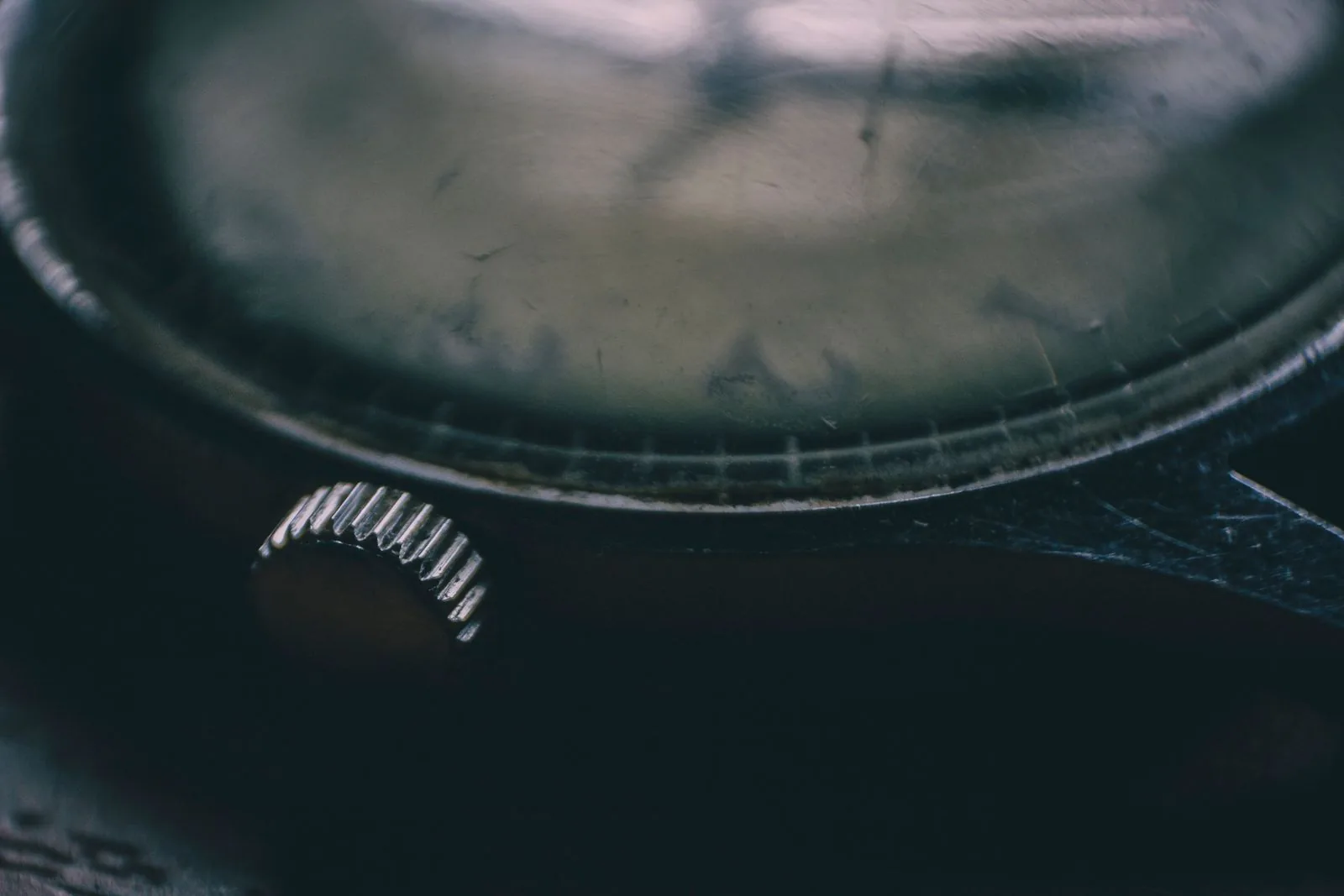
The two materials age differently. Fratello says a ceramic insert resists scratches and discoloration better, while aluminium is less prone to cracking; green aluminium on the 16610LV was especially prone to fading, with some inserts turning olive (Fratello, 2024). Fading on an aluminium insert is normal wear. Cracks or chips on a ceramic one are damage.
Turn the bezel yourself. Rolex says the Submariner bezel turns only counterclockwise, for safety, so that an accidental turn can only shorten the dive time shown (Rolex, 2020). It should not turn clockwise. Fratello’s buying guide adds that an aftermarket bezel is worse than a genuine Rolex service bezel, and that identifying original parts needs expert knowledge (Fratello, 2020). If the insert looks too new for the rest of the watch, ask whether it was replaced and by whom.
How do you check the bracelet and Glidelock clasp?
Check that the bracelet is the right one for the reference, then try the clasp. On current models, Rolex’s Glidelock system lets you adjust the bracelet length in steps of about 2 mm, up to around 20 mm, without tools, so the watch fits over a diving suit (Rolex, 2020). It should slide and lock firmly in each position.
Glidelock first appeared on the 2008 gold Submariner Date (Wikipedia, Rolex Submariner). Steel five-digit models used a stamped clasp, which Rolex used until 2010 (Fratello, 2026). So a 16610 with a Glidelock clasp, or a 126610LN with a stamped one, is not as it left the factory.
Look at the bracelet from the side for stretch, where the links sag and gaps open between them. Check the clasp closes with a firm click. Fratello notes that on Rolex watches made before 2007 the serial number is engraved between the lugs at 6 o’clock, and that removing the bracelet also tells you whether it is original or has been replaced during a service or repair (Fratello, 2020). If the bracelet has been shortened, ask the seller for the spare links.
How do you test a Submariner before you pay?
Work through the functions in the order Rolex’s user guide gives them; a seller with nothing to hide will not mind. The crown positions differ between the two models: on the no-date Submariner, position 1 is winding and position 2 (first notch) sets the time; on the Submariner Date, position 2 (first notch) sets the date and position 3 (second notch) sets the time (Rolex, 2020).
| Test | What Rolex says should happen | What a problem looks like |
|---|---|---|
| Unscrew the crown | It unscrews from the screwed-down position (0) to winding (1) | Gritty, loose or cross-threaded feel; crown that will not seat |
| Wind it | Turning clockwise winds; turning the other way has no effect; 25 turns gives a partial wind | Crown that feels the same both ways, or no seconds hand movement after winding |
| Pull to set the time | The seconds hand stops so you can set the time to the second | Seconds hand that keeps running, or hands that slip |
| Set the date (Date model) | Turning clockwise changes the date; the watch keeps running | Date that jumps unevenly or sits off-centre in the window |
| Screw the crown down | Push lightly and turn clockwise until it sits against the case | Crown that will not screw fully home; the 300-metre rating depends on it |
| Turn the bezel | Counterclockwise only, with the triangle’s luminous pip visible | Clockwise movement, slipping, or a pip that is missing |
| Try the Glidelock | About 2 mm steps up to around 20 mm | Slider that will not lock in a notch |
Source: Rolex, Submariner and Submariner Date user guide (IMR-SUB-EN-20, July 2020). The phosphorescent pip in the bezel triangle is described in the same guide.
None of these tests proves the watch is genuine or healthy inside; a watchmaker’s timing check and pressure test do that. They catch the faults you can see yourself, which is reason enough to ask more questions or walk away.
What does the service history tell you?
It tells you what has been replaced and whether the case has been refinished. Rolex says that in a complete service the watch is dismantled, worn parts are replaced, and the case and bracelet are re-polished or satin-finished according to their original finish, then tested for function, water resistance, power reserve and precision (Rolex, 2020).

That means a serviced Submariner will usually have been refinished at least once. Look at the lug edges and the crown guards; Fratello asks whether the crown guards are still thick or have been polished down to points (Fratello, 2020). Our guide on signs a case has been polished shows what to look for.
On the interval, aBlogtoWatch reported in 2015 that Rolex recommended a service period of about ten years, up from three (aBlogtoWatch, 2 July 2015). A Rolex retailer and service centre, Michael Spiers, says a complete Rolex service carries a two-year Service Guarantee (Michael Spiers, checked 30 October 2026). Ask for the service paperwork with dates and what was replaced. There is no published UK price list for a Rolex service; see what a watch service costs for how to get a quote.
The 300-metre rating holds only with the crown screwed down. Rolex says the crown should never be unscrewed underwater (Rolex, 2020). If the history shows no recent water-resistance test, have one done before you swim with it.
Which papers and checks matter for a Submariner?
Ask for the warranty card or papers, the serial number and proof of how the seller came by the watch. Rolex extended its warranty to five years for watches sold by authorised dealers from 1 July 2015 (aBlogtoWatch, 2015). A watch sold after that date may still be inside it, if the card is dated and correctly completed.
Papers can be copied too. Fratello warns that Rolex papers are faked as well as watches, and that box, booklets and accessories should belong to the specific watch (Fratello, 2020). Match the serial on the papers to the one on the watch. Then run a stolen watch check on that serial before you pay. If the seller has no papers at all, read buying a Rolex without box and papers first.
If you are unsure the watch is genuine, have it examined by a watchmaker or a Rolex service centre. The signs a watchmaker looks for are in how to spot a fake Rolex. Rolex’s history and the rest of its range are on our Rolex brand page.
Worked example: does this Submariner listing add up?
This listing is illustrative, not real. Say a seller describes a watch as “Submariner Date 16610, 2009, ceramic bezel, Glidelock clasp, blue-glowing lume, box and papers”.
- Reference against year. A 16610 made in 2009 is plausible: the reference ran to 2010 (Fratello, 2026).
- Bezel. A 16610 had an aluminium insert; ceramic came to the steel Submariner Date with the 116610LN (Fratello, 2024; Monochrome, 2020). A ceramic insert means the bezel is not original, or the watch is not a 16610.
- Clasp. Steel five-digit models kept the stamped clasp until 2010; Glidelock arrived with the six-digit Super Case watches (Fratello, 2026; Wikipedia). A Glidelock clasp is a second part from another generation.
- Lume. The 16610 moved from tritium to Super-LumiNova in 1998; Chromalight, with its blue glow, is a six-digit feature (Fratello, 2026; Rolex, 2020). Blue lume is a third mismatch.
- Papers. If the papers say 116610LN, the listing has simply given the wrong reference, and the watch may be a correct 116610LN. If they say 16610, you are looking at a five-digit watch with three later parts fitted, or something worse.
Three mismatches do not prove a fake, but the listing cannot be taken at face value. Ask which reference is on the papers and check the serial on the watch against them. A watchmaker can confirm the calibre, though here it will not settle things: both references use the 3135.
What protection do you get from each kind of seller?
What happens if something turns out wrong afterwards depends on who sold you the watch.
| Seller | Main protection | Where it comes from |
|---|---|---|
| Rolex Certified Pre-Owned (Official Rolex Retailer) | Two-year international guarantee from the date of purchase, with a seal and guarantee card | Goldsmiths, an Official Rolex Retailer |
| UK dealer (in person or online) | Goods must be of satisfactory quality, fit for purpose and as described; 30-day short-term right to reject faulty goods | Consumer Rights Act 2015, sections 9 to 11 and 22 |
| UK dealer, bought online or by phone | Also 14 days to cancel, counted from the day after you receive the watch | Consumer Contracts Regulations 2013, regulation 30 |
| Private seller | The watch must match its description; the Consumer Rights Act covers sales by traders, not private individuals | Sale of Goods Act 1979, section 13; Consumer Rights Act 2015, section 2 |
Sources: Goldsmiths, Rolex certification; Consumer Rights Act 2015, sections 2, 9 and 22; Consumer Contracts Regulations 2013, regulation 30; Sale of Goods Act 1979, section 13. All checked 30 October 2026.
Section 9 of the Consumer Rights Act counts “appearance and finish” and “freedom from minor defects” as aspects of quality, judged by what a reasonable person would consider satisfactory given the description, so keep the dealer’s written description of condition, service and parts. Goldsmiths says each Certified Pre-Owned watch goes through the same controls as Rolex after-sales service (Goldsmiths, checked 30 October 2026).
If you buy from a seller outside the UK, add the import cost: for goods over £135 sent from abroad, you pay VAT to the delivery company before delivery or when you collect, and customs duty can apply too (GOV.UK, checked 30 October 2026).
Frequently asked questions
Which Submariner references are the most common pre-owned?
In the modern steel range, the date references are the 16610, 116610LN and 126610LN, and the no-date references are the 14060 or 14060M, 114060 and 124060. Each belongs to a different generation, with a different movement, bezel or case (Fratello, 2026; SJX Watches, 2020).
When did the Submariner get a ceramic bezel?
Rolex moved the Submariner to ceramic in 2008, starting with precious-metal models; the steel Submariner Date 116610LN followed about two years later (Monochrome Watches, 2020). Five-digit references such as the 16610 have an aluminium insert (Fratello, 2024).
Is a faded aluminium bezel a problem?
Fading is normal wear on an aluminium insert, and Fratello notes that green inserts on the 16610LV were especially prone to it (Fratello, 2024). Check that the insert is genuine and suits the reference. A replaced insert should be disclosed by the seller.
What size is the Rolex Submariner?
The current Submariner and Submariner Date have a 41 mm case (Rolex, 2020). Earlier modern references, including the 16610, 116610LN and 114060, are 40 mm (Fratello, 2026). The 2020 change also widened the lug spacing from 20 mm to 21 mm.
What is the Glidelock clasp?
It is Rolex’s tool-free extension built into the clasp. Rolex says it adjusts the bracelet in about 2 mm steps up to around 20 mm (Rolex, 2020). It first appeared on the 2008 gold Submariner Date (Wikipedia).
Which way should a Submariner bezel turn?
Counterclockwise only. Rolex says this is for safety: an accidental turn can only shorten the dive time shown (Rolex, 2020). A bezel that turns both ways, or slips, needs looking at.
How often does a Submariner need a service?
aBlogtoWatch reported in 2015 that Rolex recommended a service interval of about ten years, up from three (aBlogtoWatch, 2015). Rolex’s own user guide recommends periodic servicing at an Official Rolex Retailer or Service Centre (Rolex, 2020).
Does a Rolex service polish the case?
Yes. Rolex says the case and bracelet are re-polished or satin-finished according to their original finish during a complete service (Rolex, 2020). That is why many serviced Submariners show softer edges than new ones.
Is the Submariner date or no-date better to buy?
Neither is better; it is a question of taste. The Date adds a date window and a Cyclops lens over it; the no-date has a plain dial (Rolex, 2020). In the current range both have the same case, depth rating and bezel (Rolex, 2020).
What do LN, LV and LB mean in a Submariner reference?
They describe the bezel colour, from French: LN is lunette noire (black), LV lunette verte (green) and LB lunette bleue (blue). The last digit of the number shows the metal, such as 0 for steel and 9 for white gold (WatchGuys, checked 30 October 2026).
What else should I look at?
Use the general Rolex checklist linked at the top of this page alongside the Submariner checks, and compare similar divers in our guide to Submariner alternatives.
Sources (checked 30 October 2026)
- Rolex, Oyster Perpetual Submariner and Submariner Date user guide (IMR-SUB-EN-20, July 2020)
- Fratello, Rolex Submariner: five-digit or six-digit (Robert-Jan Broer, June 2026)
- Fratello, Comparing green-bezel, black-dial Subs: 16610LV vs 126610LV (Thomas van Straaten, 21 August 2024)
- Fratello, Buying guide: how to buy a pre-owned Rolex watch (Robert-Jan Broer, 13 November 2020)
- Monochrome Watches, History of the Rolex Submariner, part 4: the modern ceramic references (Tom Mulraney, 21 August 2020, updated 20 December 2024)
- SJX Watches, Rolex introduces the Submariner 41 mm (1 September 2020)
- Wikipedia, Rolex Submariner
- aBlogtoWatch, Rolex 5-year warranty for all new watches and 10-year service intervals (2 July 2015)
- Michael Spiers (Rolex retailer), Rolex servicing
- WatchGuys (pre-owned dealer), Rolex reference numbers
- Goldsmiths (Official Rolex Retailer), Rolex Certified Pre-Owned: the Rolex certification
- Consumer Rights Act 2015, sections 2, 9 and 22
- Consumer Contracts (Information, Cancellation and Additional Charges) Regulations 2013, regulation 30
- Sale of Goods Act 1979, section 13
- GOV.UK, Tax and customs for goods sent from abroad
We check the facts in this guide against the sources named, and it is correct to the best of our knowledge as of October 2026. Rules, rates and sellers' terms change, so confirm the details with the seller, or with a professional, before you buy.