To tell if a watch has been polished, look at the edges and the finishes rather than the shine. Polishing removes metal, so a polished case tends to have softer, rounded edges, bevels that have faded or vanished, and blurred lines where brushed and polished surfaces meet. Compare the watch with photos of the same reference in original condition, and ask the seller directly.
Polishing is refinishing a case or bracelet with abrasives to remove scratches and restore shine. Brushing, also called a satin or hairline finish, is the fine, straight-grained texture on many steel cases. A bevel (or chamfer) is a narrow angled surface along an edge, often polished to catch the light.
What does polishing do to a watch case?
It removes a thin layer of metal to take out scratches. Done well, the amount removed is small and the case keeps its shape. Done badly, it rounds edges, flattens lug surfaces, blurs the line between brushed and polished areas, and can remove bevels altogether. Once the metal is gone it cannot be put back.
Fratello’s 2023 look at professional refinishing explains why technique matters. A flat surface needs a lapping wheel to stay flat with hard angles; using a soft polishing wheel on it will “round off the flat surface and edges”. The hairline finish gives a hard edge, whereas the polishing wheel leaves a vague transition. The author notes that some owners have received their watches back “sans the bevels” (Fratello, 2023).
Each polish takes a little more. Fratello’s 2020 guide says there is only so many times a case can be polished before the removal of material starts to affect its shape (Fratello, 2020). Time+Tide puts it the same way for vintage cases: over-polishing can erase edges, flatten bevels and soften lug tips (Time+Tide, 2026).
How can you tell if a watch has been polished?
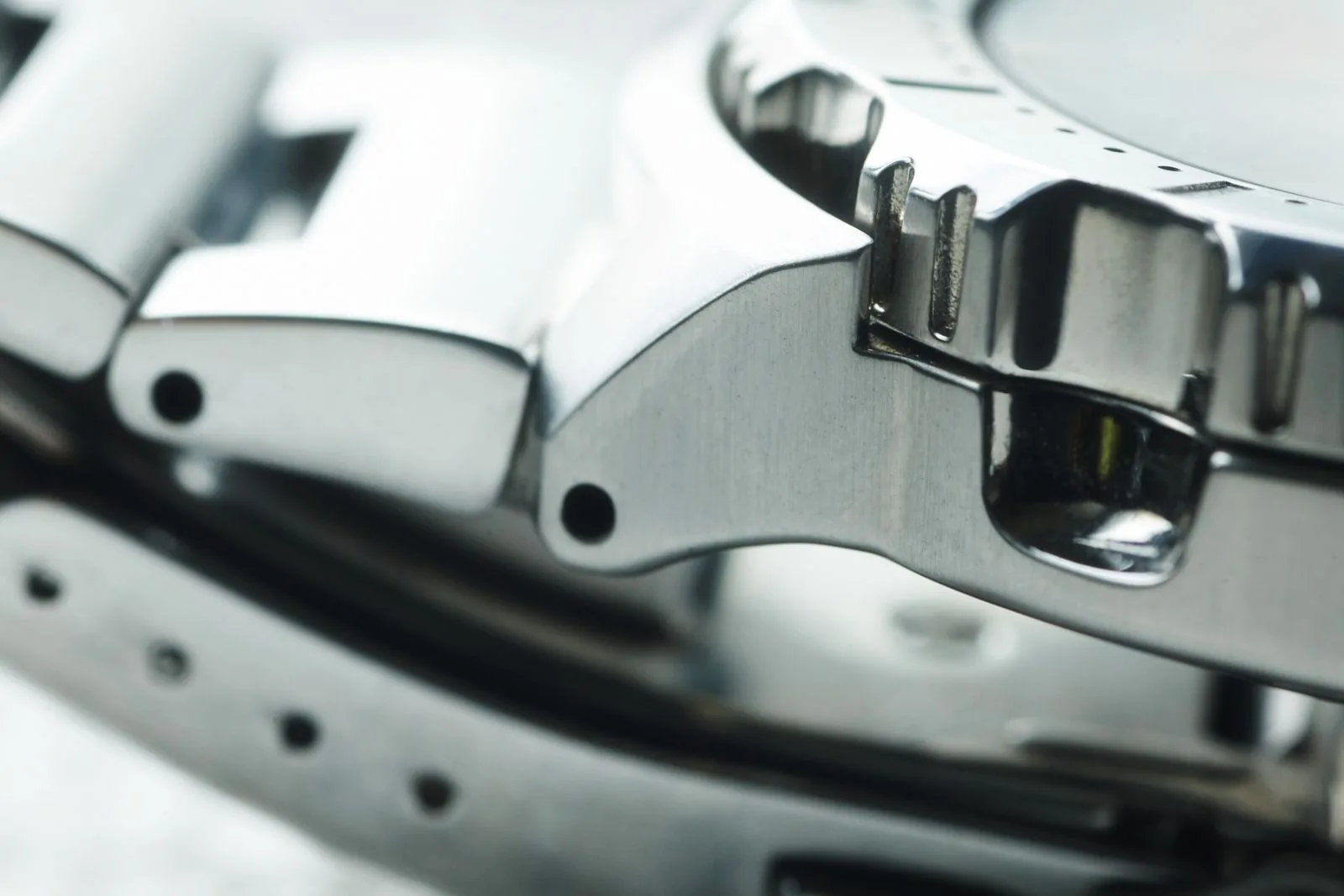
Look for lost definition. Signs of polishing are rounded case flanks, flat spots or soft tips on the lugs, bevels that are faint or missing, brushed areas that look cloudy or shiny instead of crisp, and blurred borders between finishes. A light, skilled polish can be hard to see, so the absence of these signs is not proof of an untouched case.
| Sign | What it suggests | How to check | Source |
|---|---|---|---|
| Rounded case flanks | Flat sides polished on a soft wheel | Look along the case side in raking light | Fratello, 2023 |
| Flat spots or soft lug tips | Metal removed from the lugs | Compare lug shape with photos of the same reference | Fratello, 2023; Time+Tide, 2026 |
| Faint or missing bevels | Edge facets polished away | Check the edges that should catch the light | Fratello, 2023; Time+Tide, 2026 |
| Cloudy or shiny brushing | Brushed finish redone without the right depth or direction | Look for a straight, sharp, even grain | Fratello, 2023 |
| Blurred finish transitions | Polishing wheel run across the border | Check where brushed meets polished | Fratello, 2023 |
| Crown guards worn to points | Repeated polishing of protruding parts | Compare with the original profile | Fratello Rolex guide, 2020 |
Sources: Fratello, Making a case for refinishing (Thomas van Straaten, 17 January 2023); Fratello, How to buy a pre-owned Rolex (Robert-Jan Broer, 13 November 2020); Time+Tide, Why watch lovers go wild for patina (Jason Lee, 17 January 2026). Checked 29 October 2026.
Fratello’s refinishing article describes seeing “lugs with flat spots” and “plenty of sports Rolex watches with rounded case flanks” (Fratello, 2023). Its Rolex buying guide singles out the small polished facets on Rolex lugs as “an easy give-away” of a case’s history (Fratello Rolex guide, 2020).
What exactly should a lug and chamfer look like on an unpolished case?
Beyond “rounded versus sharp,” a buyer’s guide to vintage Rolex cases gives a more specific description worth learning before you compare photos. On an unpolished lug, the top surface should be matte, with an even grain running in the correct direction, and the chamfer (the narrow bevel between the top of the lug and the case side) should be even in width and as narrow as the model was made with; current references typically have no visible chamfer at all. Over-polishing shows up as lugs that have become thin and rounded, with little definition between the lug top and the case side, bottom edges that have lost their flat, sharp line, and a chamfer that has been widened by repeated polishing passes, which specialist buying guides treat as a sign that lowers a watch’s value to a collector of that model (Atelier de Griff, vintage Rolex buyer’s guide, checked 30 October 2026).
Crown guards, where a model has them, should be symmetrical and have kept their original thickness; guards that have become thin, asymmetric or lost their crisp edges on one side more than the other have usually been through more polishing on that side, sometimes from being reshaped around a replaced crown. Do not treat a small natural asymmetry between the two lugs on one side of a case as proof of polishing on its own: some models are made with a slightly thinner lug on the crown side by design, and the angle a photograph is taken at can make an evenly polished bevel look uneven. Ask for several angles before drawing a conclusion from one photo.
How do you judge polish from photos?
Ask for photos that show edges, not faces. A straight-on dial shot hides almost everything. You need the case side, the lugs from above and from the side, and the bracelet where it meets the case, all in good daylight. Compare them with photos of the same reference in original condition.
Request these shots:
- The case from each side, level with the case, so the flank’s profile is visible.
- The lugs from above and at an angle, so bevels and lug tips show.
- The bezel and crown guards, if the watch has them.
- The clasp and the first bracelet links, where brushed and polished surfaces meet.
Heavy retouching or very soft focus on the edges is a reason to ask for more photos. Our guide to watch condition grades explains why a grade alone tells you little about polishing.
How do you check for polish in hand?
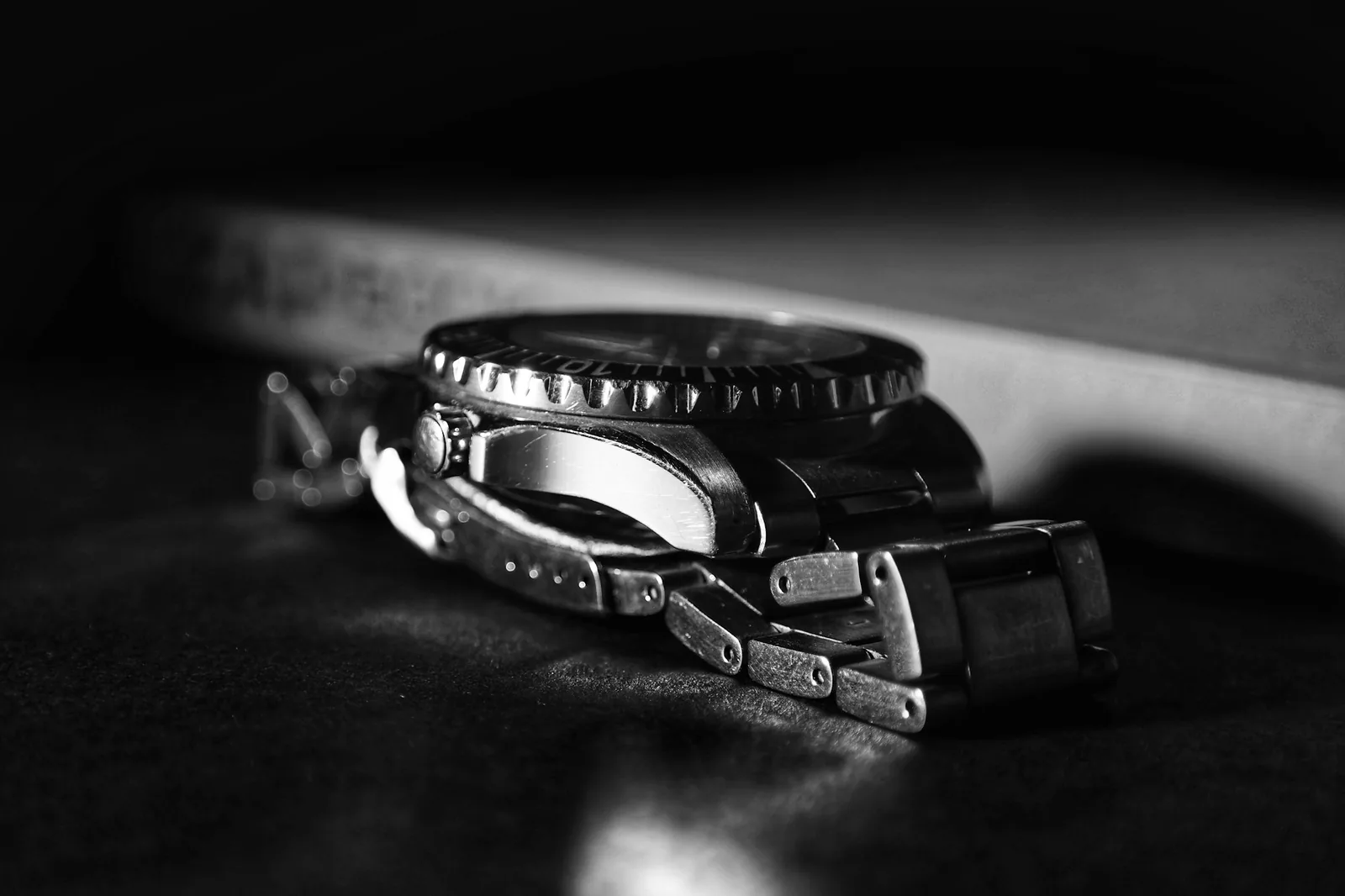
Hold the watch under a single light source and tilt it slowly. Sharp edges throw a clean line of light; rounded ones give a soft glow. Run your eye along each lug and the case flank, look at the bevels, and check that the brushed grain is straight and even. A loupe helps with the transitions.
Compare what you see with the seller’s description and with the brand’s own photos of the reference. If the watch has an engraved caseback or lugs, check that the engraving is crisp; then ask a watchmaker if anything looks soft. For a broader check, use our questions to ask before buying a used watch.
Does a brand service polish the case?
Often, yes. Omega’s complete service includes a step that restores the shine of the case and metal bracelet “while preserving the original shape of each component”, and Omega says polishing is included as a courtesy package in the service price (Omega). Rolex’s servicing procedure re-polishes or satin-finishes the case and bracelet according to their original finish (Mappin & Webb).
So a watch that has been serviced by its maker has probably been refinished, and that is normal. The point is how well and how often. If you would rather keep a case as it is, say so in writing when you book a service; Fratello advises asking for a light touch so as not to permanently damage the case’s silhouette (Fratello, 2020). See how to check if a watch has been serviced for reading service paperwork, and watch servicing costs for what a service involves.
Plated or coated cases need special care. Fratello warns owners not to refinish a plated, treated or coated case themselves, as polishing can strip the coating and expose the base metal (Fratello, 2020).
Brands differ in whether polishing is bundled into a standard service or offered separately, which affects what you should ask a seller about a watch’s most recent service. Omega includes case and bracelet polishing as a courtesy within its complete service price, and Rolex’s servicing procedure re-polishes or satin-finishes as a standard step, as described above. Panerai, by contrast, lists case and bracelet polishing as an explicitly optional add-on to its service, separate from the standard steps, and notes that polishing requires fully dismantling the case, with water resistance re-tested afterwards (Panerai, “Services”, checked 30 October 2026). That means a Panerai sent for an ordinary service may come back unpolished unless the owner asked for it, while a Rolex or Omega sent for the same kind of service is more likely to come back refinished by default. If you are buying a pre-owned watch and the case condition matters to you, ask not only whether it has been serviced, but whether polishing was requested or included in that specific service, since the brand’s default differs.
| Brand | Is polishing part of a standard service? | Source |
|---|---|---|
| Omega | Included as a courtesy within the complete service price | Omega, main steps of a complete service |
| Rolex | Standard step, re-polished or satin-finished to original finish | Mappin & Webb, Rolex servicing procedure |
| Panerai | Optional add-on, not part of the standard service steps | Panerai, Services |
Sources as cited in this guide; checked 29-30 October 2026. Terms and included steps can change, so confirm with the brand or an authorised service centre before booking.
Why does polishing matter when you buy?
It changes the watch’s shape and how much of the original case is left, and it should be reflected in how the watch is described. Collectors of older watches in particular look for sharp edges and untouched cases. Fratello’s 2020 guide says vintage collectors prefer a watch to reach them in as untouched a condition as possible (Fratello, 2020).
Time+Tide notes that a case with scratches and dings but intact lines can feel more authentic than one polished into a generic shape, while adding that polishing is sometimes necessary and sometimes done well (Time+Tide, 2026). For older pieces, our guide to buying a vintage watch covers originality more widely.
There is a legal angle too. If you buy from a trader, the watch must match its description (Consumer Rights Act 2015, section 11). A case described as unpolished that turns out to be heavily polished may not match. Keep a copy of the listing.
Here is an illustrative scenario showing why this is worth checking before you pay rather than after. Suppose a seller lists a steel sports watch as “unpolished, original condition throughout” at a price that reflects that claim, perhaps several hundred pounds above an otherwise identical polished example. On arrival, raking light across the case flank shows rounded edges and a chamfer that has clearly been widened by more than one polishing pass, inconsistent with the listing. If the listing is treated as part of the contract, as it is for a trader sale under the Consumer Rights Act, the buyer has grounds to reject the watch or seek a price that reflects its actual condition; if the buyer had not checked and simply accepted the watch, that difference in value, which specialist buying guides treat as running into hundreds of pounds for a collectable reference, would have gone unrecovered. The check costs nothing beyond a few minutes under a good light; skipping it can cost the price difference between two conditions that look similar at a glance.
What should you ask the seller about polishing?
Ask directly and get the answer in writing. A straight question is quicker than any visual check, and a seller who knows the watch’s history should be able to answer. If they do not know, that is useful information too.
Ask:
- Has the case or bracelet been polished, and if so, when and by whom?
- Was it polished as part of a brand service? Is there an invoice that says so?
- Do you have photos of the watch before it was polished?
- Has any metal been added back, for example by laser welding, before refinishing? (Fratello describes this being done to an Oyster bracelet after an accident; Fratello, 2023.)
- Will you accept a return if a watchmaker finds the case has been polished more than described?
Frequently asked questions
Is a polished watch a bad buy?
Not necessarily. Many genuine watches are polished during brand servicing, and a skilled light polish keeps the case’s shape. What matters is how much metal has gone, whether the lines are intact, and whether the description was accurate.
Can polishing be reversed?
No. Polishing removes metal, and once it is gone there is no way of putting it back by polishing alone. Fratello describes laser welding being used to add metal before refinishing a damaged bracelet (Fratello, 2023), which is specialist repair work.
Does Omega polish watches during a service?
Omega’s complete service includes cleaning and polishing the case and bracelet while preserving the original shape, and polishing is included as a courtesy in the service price (Omega). If you do not want it, ask before the work starts.
Does Rolex polish watches during a service?
Rolex’s servicing procedure includes re-polishing or satin-finishing the case and bracelet according to their original finish (Mappin & Webb, Rolex servicing procedure).
Can you tell if a watch has been polished from one photo?
Rarely. A straight-on dial photo hides the edges. You need side and angled shots of the case, lugs and bracelet in good light.
What is the difference between polishing and brushing?
Polishing gives a mirror shine. Brushing gives a fine, straight-grained satin texture. Many steel cases combine both, and Fratello notes that the brushed finish, applied last in refinishing, is very hard to get right (Fratello, 2023).
Should I ask for no polishing when I service my watch?
If you want to keep the case as it is, say so in writing when you book. Fratello suggests asking for a light touch to avoid damaging the case’s silhouette (Fratello, 2020).
How many times can a watch be polished?
There is no fixed number. Fratello says that if polishing is done properly, the material removed is kept to a minimum and it can be done a few times during a watch’s life (Fratello, 2023).
Can polishing affect a watch’s water resistance?
It can, indirectly. A case opened for polishing, as Panerai’s service description notes, needs its gaskets and seals checked and water resistance re-tested afterwards, since removing the caseback and crown disturbs the seals regardless of how carefully the case itself is handled. A watch that has recently been polished should have a water resistance test result on file; ask the seller for it rather than assuming the watch is still rated as it was from new.
Is polishing the same as restoration?
No. Polishing is one part of refinishing. Restoration can include other work, such as replacing parts or adding metal, and should be described in the seller’s paperwork.
What is a chamfer, and why does its width matter?
The chamfer (or bevel) is the narrow angled surface between the top of a lug and the side of the case. An unpolished chamfer should be even and as narrow as the model was originally made with; repeated polishing widens it over time, and a chamfer that has become noticeably wide is a specific, checkable sign of heavy refinishing (Atelier de Griff, checked 30 October 2026).
Does Panerai polish cases during a standard service?
No, not automatically. Panerai lists case and bracelet polishing as an optional add-on, separate from its standard service steps, unlike Omega and Rolex, which include polishing as a default part of their service (Panerai, Services, checked 30 October 2026). Ask whether a specific service included polishing, rather than assuming it did.
Does a dealer disclose polishing in a condition grade?
It should, but a grade such as “excellent” or “very good condition” is not a substitute for a direct answer, since grading schemes vary between dealers and do not always separately flag refinishing. Ask the question directly rather than relying on the grade alone; our guide to watch condition grades explained covers what each grade typically does and does not promise.
Should I ask to see the watch’s weight before and after a described polish?
You can’t, since polishing removes a small amount of metal that is rarely weighed before and after by a seller. What you can ask for instead is the date of the last polish, whether it was done by the brand or an independent, and photos from before the work if the seller has them. The case’s visible condition, not its weight, is the practical check available to a buyer.
Can asymmetric lugs mean a watch has been polished unevenly?
Not necessarily. Some models are made with a slightly thinner lug on the crown side by design, and photo angle or lighting can make an evenly finished bevel look uneven. Ask for several angles before concluding the case has been polished unevenly.
This page is general information, not legal advice.
Sources (checked 29 October 2026)
- Fratello, Making a case for refinishing: see how the pros do it (Thomas van Straaten, 17 January 2023)
- Fratello, You asked us: can watches be polished? (Rob Nudds, 11 July 2020)
- Fratello, Buying guide: how to buy a pre-owned Rolex watch (Robert-Jan Broer, 13 November 2020)
- Time+Tide, Why watch lovers go wild for “patina” (Jason Lee, 17 January 2026)
- Omega, main steps of a complete service
- Mappin & Webb, Rolex servicing procedure
- Consumer Rights Act 2015, section 11
- Atelier de Griff, Vintage Rolex buyer’s guide: case details to look for, checked 30 October 2026
- Panerai, Services, checked 30 October 2026
We check the facts in this guide against the sources named, and it is correct to the best of our knowledge as of October 2026. Rules, rates and sellers' terms change, so confirm the details with the seller, or with a professional, before you buy.