The difference between a mechanical and a quartz watch is the power source and the timekeeper. A mechanical watch runs on a wound spring regulated by a balance wheel; a quartz watch runs on a battery and a vibrating quartz crystal. Quartz is generally more accurate and needs less upkeep, and mechanical watches are bought for the engineering and the way they are made.
A movement is the mechanism inside the watch that keeps time. This guide compares the two main types in the context of buying a luxury watch, and it is general information.
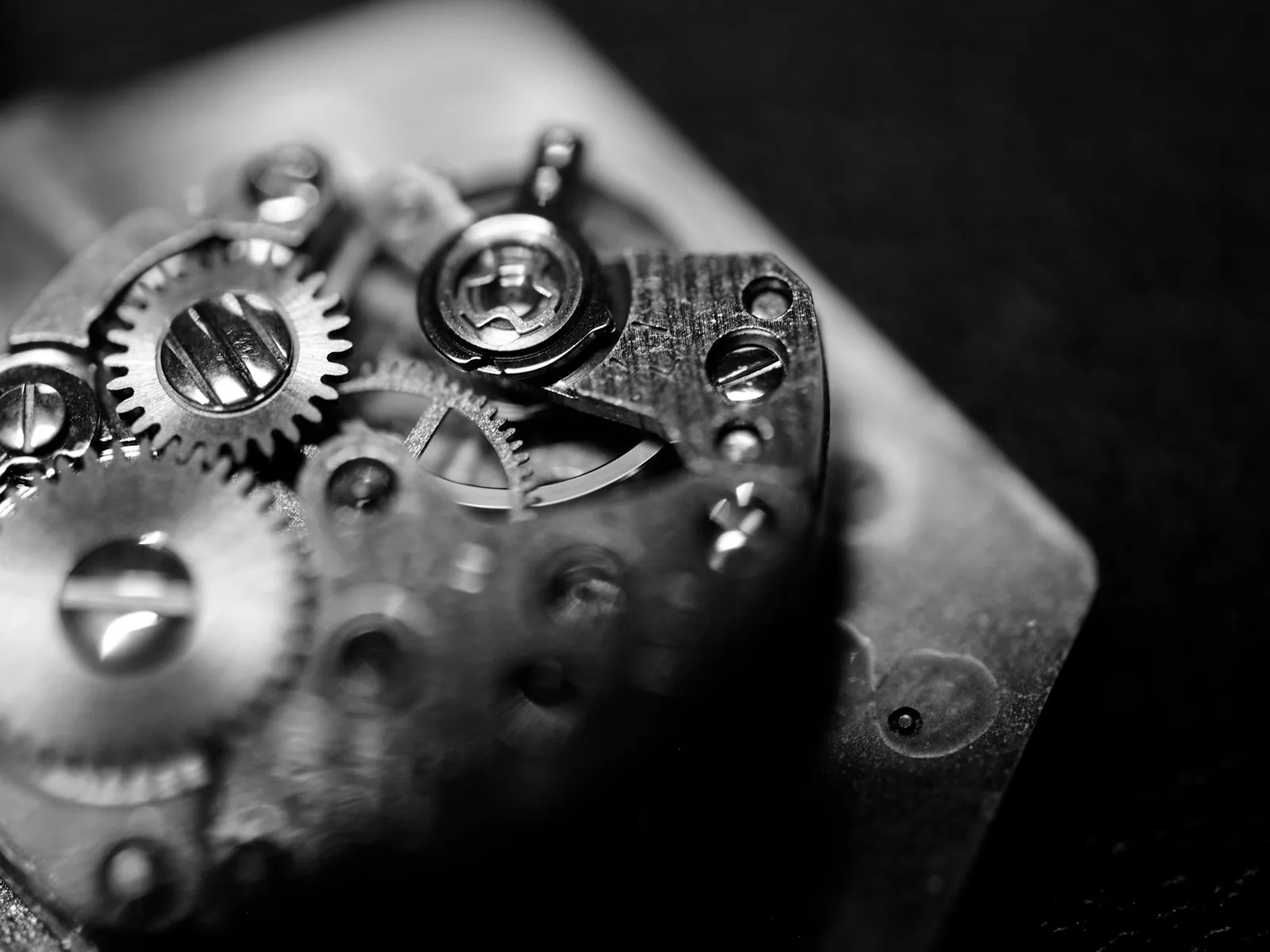
What is the difference between a mechanical and quartz watch?
In a mechanical watch, a mainspring stores energy and releases it through gears and an escapement, with a balance wheel setting the pace. Automatic versions wind themselves from wrist motion through a rotor; hand-wound ones are wound at the crown. In a quartz watch, a battery sends current through a small quartz crystal, which vibrates at a steady frequency, and electronics convert that into the movement of the hands (Gentleman’s Gazette, 2026).
You can often tell which type you are looking at without opening the case:
| Clue | Mechanical | Quartz |
|---|---|---|
| Seconds hand | Glides in a smooth sweep | Moves in a single tick per second |
| Weight for its size | Usually heavier, from the mainspring barrel, gear train and (on automatics) a rotor | Usually lighter, from the battery and circuit board |
| Setting the date or time | The crown has little resistance; a quick-set date is common but not universal | Hands or date can jump sharply when the crown is pulled |
| If it stops | A hand-wound or automatic watch stops when unworn for a few days (its power reserve) | A stopped quartz watch almost always needs a new battery |
| Sound close to the ear | A faint mechanical tick from the escapement | Usually silent, or a very quiet electronic tick |
Source: general movement description, Gentleman's Gazette, Watch movements explained, checked 29 October 2026. These are buyer's clues, not a technical test, and some hybrid and high-end quartz movements blur them.
| Mechanical | Quartz | |
|---|---|---|
| Power | Wound mainspring | Battery |
| Timekeeper | Balance wheel and escapement | Quartz crystal |
| Seconds hand | Usually sweeps smoothly | Usually ticks once a second |
| Upkeep | Periodic service | Battery change; occasional service |
| Typical accuracy | Seconds per day, adjustable | Seconds per month |
Sources: accuracy and upkeep rows from Seiko's instruction manuals for its 6R15 automatic (factory-adjusted daily rate of +25 to −15 seconds) and 7N36 quartz (monthly rate of less than 15 seconds; battery life about 4 years; a check every 2 to 3 years) movements, checked 29 October 2026. Figures differ by movement.
Our watch terms glossary defines the other words you will see in listings, such as rotor, escapement and power reserve.
Are there movement types other than mechanical and quartz?
Yes, and a pre-owned buyer will meet at least two of them often enough to be worth knowing. A hybrid movement borrows from both systems, and a solar movement is a variant of quartz rather than a third category.
Spring Drive, made by Seiko and used across Grand Seiko, replaces the mechanical escapement with an electromagnetic brake governed by a quartz crystal, while still being wound by a mainspring like an automatic. The result is the smooth sweeping hand of a mechanical watch with quartz-level timekeeping. Grand Seiko’s own published figure for its 9R15 calibre, a specially adjusted version of the 9R65, is an accuracy of plus or minus 10 seconds a month (about plus or minus 0.5 seconds a day); the standard 9R65 is rated to plus or minus 15 seconds a month (Grand Seiko, Calibre 9R15, checked 30 October 2026). That sits between a COSC mechanical chronometer and an ordinary quartz watch, and it needs the same kind of periodic service as a mechanical movement because it still has a mainspring, gear train and oil.
Solar quartz, sold by Citizen as Eco-Drive and by others under their own names, is an ordinary quartz movement powered by a panel under the dial instead of a replaceable battery, charged by any light. Citizen’s standard Eco-Drive accuracy claim is the same as conventional quartz, around 15 seconds a month, but the brand has also built specialist calibres with far tighter tolerances: its Calibre 0100, launched in 2019, is rated to an annual accuracy of plus or minus 1 second a year, which Citizen called “the world’s most accurate Eco-Drive watch” at launch (Citizen, “Ultimate Precision”, checked 30 October 2026). For a pre-owned buyer, the practical point is that a solar quartz watch never needs a battery change, but the rechargeable cell behind the panel can eventually wear out and need replacing by a specialist, usually after a decade or more of use, so ask the seller whether that has been done.
Kinetic movements, another Seiko line now largely discontinued, charge a rechargeable cell from the wearer’s wrist motion, like an automatic watch, but keep time with a quartz crystal. Buyers of older kinetic watches should ask specifically about the capacitor or rechargeable cell’s condition, since these do wear out and are a specific, model-dependent part to source.
None of these variants changes the basic trade-off in this guide: Spring Drive and solar quartz both still sit on the quartz side for accuracy and upkeep, while asking a bit more of the seller’s paperwork because they are less common for an independent watchmaker to service.
How accurate are mechanical and quartz watches?
Quartz is more accurate as standard. A mechanical watch is regulated by hand and affected by position, temperature, magnetism and how recently it was wound, so it can gain or lose several seconds a day. Quartz watches typically drift by seconds a month.
Mechanical watches can be certified. COSC, the Swiss official chronometer testing body, says its “Chronometer Certified” standard is based on ISO 3159, is generally tested on the movement, and requires an average daily rate of −4 to +6 seconds a day. Its newer “Excellence Chronometer Certified” label is tested on the finished watch, to −2 to +4 seconds a day (COSC, checked 29 October 2026). Makers may also have their own, tighter standards, which are marketing claims you can compare but not independently assume. Ask what the claim covers: the loose movement, or the finished watch.
Put in practical terms: a COSC-certified mechanical movement running at the loose end of its tolerance, +6 seconds a day, could be about three minutes fast after a fortnight if never reset. Seiko’s 7N36 quartz calibre, rated to drift by less than 15 seconds a month, would still be well under 15 seconds out after the same fortnight (Seiko 7N36 instructions, checked 29 October 2026). Both are easily corrected by resetting the time; the difference is how often you would want to.
A few makers test and certify beyond the loose movement, which is where the figures tighten further. Omega’s Master Chronometer standard, tested by METAS (the Swiss Federal Institute of Metrology) on the finished, cased watch rather than the bare movement, requires a daily rate within 0 to +5 seconds (Watchfinder & Co., “What’s a METAS Master Chronometer certification?”, checked 30 October 2026). That is tighter than the plain COSC range of −4 to +6 seconds a day this guide quotes above, because it is a one-sided tolerance biased towards running fast rather than slow, and because it is checked on the complete watch, including after exposure to a strong magnetic field as part of the same test. Grand Seiko’s mechanical movements, by contrast, are regulated in-house to the brand’s own “Special Grade” or “VFA” standards rather than sent to COSC, and the figures vary by calibre and grade, so ask for the specific movement’s published tolerance rather than assuming a single Grand Seiko number.
| Standard | Who certifies | What it tests | Daily rate |
|---|---|---|---|
| COSC Chronometer | COSC (Switzerland) | Loose movement, before casing | −4 to +6 seconds |
| COSC Excellence Chronometer | COSC | Finished, cased watch | −2 to +4 seconds |
| Omega Master Chronometer | METAS | Finished watch, incl. magnetism exposure | 0 to +5 seconds |
| Ordinary quartz (e.g. Seiko 7N36) | Maker’s own spec | Movement | About 15 seconds a month |
| Spring Drive 9R15 | Maker’s own spec (Grand Seiko) | Movement | About 10 seconds a month |
Sources: COSC, as cited above; Watchfinder & Co., METAS Master Chronometer certification; Seiko 7N36 instructions, as cited above; Grand Seiko, Calibre 9R15. Checked 30 October 2026. Figures are for the specific calibres named, not every watch bearing that certification.
Does magnetism or temperature affect one type more than the other?
Mechanical watches are the more exposed of the two. A magnetic field can pull on the steel balance spring and make the watch run fast, sometimes dramatically, until a watchmaker demagnetises it; temperature swings expand and contract metal parts and change the oil’s viscosity, which is part of why a mechanical movement’s accuracy is usually quoted across a range rather than a single number. Quartz movements are far less affected by ordinary magnetic fields, because there is no spring to pull on, though very strong fields can still disrupt the circuit or a step motor temporarily.
Some mechanical watches are built specifically to resist magnetism, and the figures vary enormously by design. Rolex’s Milgauss, as its name states, is built to resist up to 1,000 gauss. Omega’s antimagnetic movement technology, introduced from 2013 and now standard across most Master Chronometer models, resists fields of 15,000 gauss or more, which Omega and independent watch press describe as more than ten times the Milgauss figure and realistically beyond any field most owners will ever encounter outside a hospital MRI suite or an industrial setting (WatchesBySJX, “Omega antimagnetic movement resistant to >15,000 gauss”, checked 30 October 2026). For most buyers this is not a practical concern day to day, but it matters if you work near MRI equipment, industrial magnets or certain audio equipment, and it is a reasonable question to put to a seller if a watch has started running unusually fast.
What does each type cost to keep running?
A quartz watch needs a battery change every few years, depending on the model. Seiko, for example, gives an approximate battery life of 2 to 5 years across the quartz calibres in one manual (Seiko 7N36 instructions, checked 29 October 2026); check your watch’s manual. A mechanical watch needs servicing, which is cleaning, oiling and adjustment, and the cost and interval vary by maker and complexity. Neither figure is fixed here because prices differ by brand, and this guide makes no price claims.

What you can do is ask before you buy. Ask the seller or maker for the recommended service interval and a current price range for a service on that model. Then add that to your budget with insurance (see watch insurance in the UK).
Servicing a mechanical watch is explained in how to care for a mechanical watch.
To make the cost difference concrete, here is a purely illustrative example over ten years of ownership, not a quote for any specific watch: a quartz watch needing a battery roughly every four years (in line with Seiko’s 2 to 5 year range for the 7N36) would need about two to three battery changes in that time, each a low-cost job at a watch repairer or jeweller. A mechanical watch recommended for service every four to six years, in line with Breitling’s stated interval, would need one or two full services in the same period, and a mechanical service is a more involved job than a battery change because it means stripping, cleaning, oiling and regulating dozens of parts rather than swapping one component. Neither this guide nor Watch60 states a price for either job, because both vary by brand, movement and who carries out the work; get a current, written quote from the seller, the brand’s service centre or an independent watchmaker before you buy, and budget for at least one of whichever service applies within your likely ownership period.
Which lasts longer and is easier to repair?
Both can last for decades if looked after. Mechanical watches can in principle be serviced indefinitely if parts remain available, and many owners keep one for years. Quartz watches have fewer moving parts, but electronic modules can be difficult to repair on some models. Parts availability depends on the maker and the age of the watch, so ask about support for the specific model.
Servicing history matters on pre-owned watches; ask for it in writing. See watch condition grades explained for the other things to ask about wear.
A frequent, practical question is which type suits someone who travels often or changes time zones regularly. Neither type has a built-in advantage here: a GMT or world-time function, which some mechanical and some quartz watches both offer, is what actually helps with time zones, not the movement type itself. What does differ is tolerance for being left unworn: an automatic watch left in a drawer during a trip will need resetting on return once its power reserve runs out, where a quartz watch will simply have kept running. If you wear a watch daily, this rarely matters in practice.
Should you buy a mechanical or quartz watch?
Choose by how you will wear it. If you want a watch you can pick up after weeks and find correct, quartz is more practical. If you want to own a machine that is made and finished by hand, a mechanical watch gives you that, with the upkeep that goes with it. Many collectors own both.
Neither choice is an investment decision, and Watch60 makes no claims about future prices. For the rest of the buying process, see the guide to buying a luxury watch.
Frequently asked questions
Is a mechanical watch better than quartz?
Not in every way. Quartz is more accurate and needs less upkeep; mechanical is valued for craftsmanship.
Are quartz watches cheaper?
Often, but not always. Some quartz watches cost as much as mechanical ones. Compare listings.
Do automatic watches need winding?
An automatic winds as you wear it. If you leave it, it stops after its power reserve runs out.
How long does a mechanical watch run unworn?
That is the power reserve, which varies by movement. Check the specification.
How often do you service a mechanical watch?
The maker sets the recommended interval. Breitling, for example, recommends a complete service every four to six years (Breitling, checked 29 October 2026). Ask the seller.
Can a quartz watch be luxury?
Yes. Some makers use high-grade quartz movements, and buyers choose them for accuracy.
What does “chronometer” mean?
A movement tested for accuracy by an official body such as COSC. Our guide to COSC chronometer certification explains the test.
Are mechanical watches affected by magnets?
Yes. Magnetism can make them run fast; a watchmaker can demagnetise them. Some modern mechanical movements, such as Omega’s Master Chronometer calibres, are built to resist magnetic fields of 15,000 gauss or more, far beyond older antimagnetic watches like the Rolex Milgauss at 1,000 gauss (WatchesBySJX, checked 30 October 2026).
What is Spring Drive, and is it mechanical or quartz?
It is a hybrid. A Spring Drive watch, made by Seiko and used in Grand Seiko, is wound by a mainspring like a mechanical automatic but regulated electronically by a quartz crystal, giving a smooth sweeping hand with quartz-level accuracy of around 10 to 15 seconds a month depending on the calibre (Grand Seiko, checked 30 October 2026). It still needs the periodic servicing a mechanical watch does.
What does “high-accuracy quartz” mean on a listing?
It usually means a quartz movement built and adjusted to a tighter tolerance than an ordinary mass-market quartz calibre, sometimes called a thermocompensated or high-frequency movement. Grand Seiko’s 9F quartz calibre, for example, is stated by the brand to be accurate to within plus or minus 10 seconds a year, far tighter than the roughly 15 seconds a month quoted for an ordinary quartz movement like Seiko’s 7N36 (Grand Seiko, quartz movement, checked 30 October 2026). A watch advertised this way should name the specific calibre and its stated tolerance, not just the words “high accuracy.”
Can a quartz movement be serviced like a mechanical one?
To a lesser degree. A quartz movement has far fewer moving parts, so routine servicing mainly means a battery change and checking gaskets for water resistance, rather than the full strip-down a mechanical service involves. Some quartz movements also use a stepping motor and gear train to drive the hands, which can wear and occasionally need replacing, but this is less frequent and usually less costly than a mechanical service.
Does a solar-powered quartz watch ever need a new battery?
Not a disposable one, but the rechargeable cell behind the solar panel can wear out after many years and need specialist replacement. Ask a seller of an older solar quartz watch when the cell was last checked or replaced.
This page is general information, not financial advice.
Sources (checked 29 October 2026)
- COSC, COSC certifications and Chronometer Certified
- Seiko, 6R15 instruction manual and 7N36 instruction manual
- Breitling, service
- Gentleman’s Gazette, Watch movements explained, checked 29 October 2026
- Grand Seiko, Calibre 9R15, checked 30 October 2026
- Citizen, “Ultimate Precision” (Calibre 0100 launch), checked 30 October 2026
- Watchfinder & Co., What’s a METAS Master Chronometer certification?, checked 30 October 2026
- WatchesBySJX, Omega antimagnetic movement resistant to >15,000 gauss, checked 30 October 2026
- Grand Seiko, quartz movement, checked 30 October 2026
We check the facts in this guide against the sources named, and it is correct to the best of our knowledge as of October 2026. Rules, rates and sellers' terms change, so confirm the details with the seller, or with a professional, before you buy.