This watch storage guide comes down to four rules: keep each watch in its own padded space, somewhere dry and away from heat, sunlight and magnets; use a winder only if it saves you resetting a watch you care about keeping set; and if a watch is valuable, read your insurance conditions, because some policies only cover theft from home if the watch is locked in a safe of the right rating.
Watch storage here means where a watch lives when it is not on your wrist: a box, a roll, a winder or a safe. This guide is general information. Your watch’s manual and your insurance policy override it.
How should you store a watch collection?
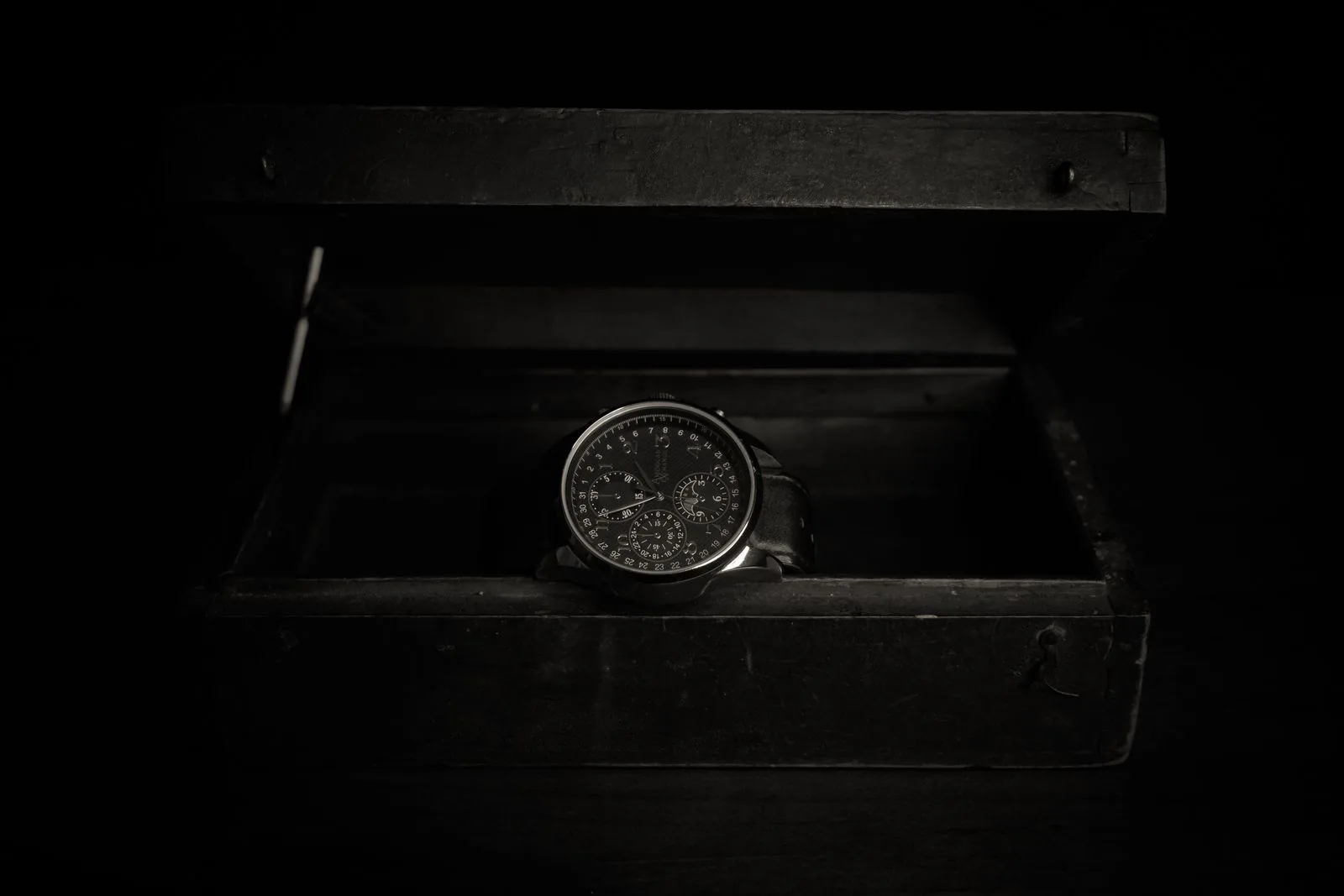
Give each watch its own soft compartment so the cases and bracelets do not touch. Keep the box in a dry room at normal room temperature, out of direct sun and away from speakers and other magnets. Store the boxes and papers separately, and keep a record of every serial number somewhere other than the watches.
Longines advises keeping watches between 10°C and 27°C, with humidity ideally below 50%, and out of prolonged direct sunlight, which it says can fade dials and damage leather straps (Longines, 2026). It recommends a watch box with padded compartments to prevent scratches.
The original box and papers matter when you sell, so store them flat and dry even if the watch lives elsewhere. Our guide to what a “full set” includes lists what to keep.
Which watch storage options suit which watch?
A padded box suits most collections at home. A roll or travel case suits carrying. A winder suits automatic watches you want kept running. A safe is for security and, for valuable watches, can be an insurance condition. Most collectors use more than one.
| Option | What it does | Points to check | Source |
|---|---|---|---|
| Watch box | Keeps watches organised; padded compartments prevent scratches | One watch per compartment; lined lid; dry room | Longines, 2026 |
| Watch roll or travel case | Protection and portability on the move | Firm sides; each watch held separately | Longines, 2026 |
| Watch winder | Moves an automatic watch to keep the mainspring wound; convenient, not essential | Motor away from the watch; settings to suit the movement | Longines, 2026 |
| Safe | Resists burglary to a tested grade | Grade and cash rating; fitted as the maker recommends; meets your policy | BSI; Pen Underwriting |
| Quartz watch stored long term | Battery check yearly | Battery out if storing for over a year, by a watchmaker | Longines, 2026 |
Sources: Longines, how to store a watch; BSI, BS EN 1143-1; Pen Underwriting, EHH household endorsement library. All checked 29 October 2026.
Do you need a watch winder?
No. A watch winder is a powered stand that turns an automatic watch to keep it wound while you are not wearing it. Longines describes one as convenient but not essential: it keeps the mainspring wound and, it says, helps preserve the lubricants (Longines, 2026). A stopped automatic is not harmed; you simply wind and set it again.
A winder earns its place on a watch that is fiddly to reset. A perpetual calendar or moon phase can take time to set correctly, and setting some calendar mechanisms at the wrong time of day can damage them. Seiko’s manual for its 6R15 movement, for example, says not to set the date between 10pm and 1am (Seiko). Our guide to what each watch complication does covers these in more detail.
Two cautions. First, magnets: a winder has an electric motor. Omega recommends avoiding powerful magnetic fields such as loudspeakers and fridges (Omega, 2026). Ask the winder’s maker how the motor is placed and shielded, and if a watch starts running fast after time on a winder, have a watchmaker test it for magnetism. Second, settings: use the turns and direction the watch maker or the winder maker gives for your calibre.
What turns-per-day setting should a winder use?
Turns per day (TPD) is how many full rotations a winder makes in 24 hours, and most winders let you set it, along with the direction of rotation (clockwise, anticlockwise or bidirectional), to suit the movement inside. Neither Rolex, Omega nor the other brands in this guide publish an official TPD figure for their own movements, so any number you see quoted, including the ranges below, comes from winder makers and watch forums rather than the brands themselves; treat it as a starting point to refine by checking the watch still shows a full power reserve the next day.
One UK winder maker, Barrington Watch Winders, sells models with adjustable TPD from 650 to 1,950 and clockwise, anticlockwise and bidirectional modes, and publishes brand-by-brand suggested ranges on its site; its own figures are not fully consistent between pages, for instance citing both 650–800 and 650–900 as a “typical” range for the same category of movement, which is itself a reason to treat any single published number cautiously (Barrington Watch Winders, checked 30 October 2026). The winding mechanism inside a watch, not its brand name, determines what it actually needs: a movement that winds in both directions as the rotor swings generally needs fewer turns to stay fully wound than one that only winds in a single direction, because every rotation counts toward winding it rather than only every other one.
If you are not sure which way your movement winds, check the watch’s own manual or ask a watchmaker rather than guess, since a bidirectional-winding watch set on a winder that only turns one way will still wind, just more slowly, while the wrong setting on a winder is unlikely to damage a modern movement but can leave it under or overwound relative to what it needs. Start on the lower end of a winder’s range, check the watch’s power reserve indicator or timekeeping after 24 to 48 hours, and adjust from there.
How do humidity, heat and magnets affect a stored watch?
Damp can get into a case and cause corrosion or condensation. Heat and cold change how the oils in a movement behave. Magnets can make a mechanical watch run fast. A dry room at normal temperature, away from speakers, bags with magnetic clasps and electronics, avoids all three.
Longines says humidity can introduce moisture into the case and risk corrosion, and that extremes of cold or heat can alter how lubricants behave. It advises against hot car interiors and damp bathrooms (Longines, 2026). Seals age even in a drawer: Seiko’s UK pages say water resistance is not permanently guaranteed and is affected by ageing gaskets (Seiko UK, 2026). A watch that has been stored for years should be pressure tested before it gets wet.

On magnetism, Omega makes an exception for watches with its Master Co-Axial Chronometer movements, which it says resist magnetic fields above 1.5 tesla (Omega, 2026). Other watches are more sensitive. Keep the watch box off the top of a speaker or a router. For the rest of the routine, see looking after a mechanical watch.
Do you need a safe to insure a watch collection?
Sometimes. It depends on the policy and the value of each watch. Some household policies exclude theft of valuable watches from the home unless they are being worn, kept under your supervision, or locked in a safe. Where a policy has that condition, the safe usually has to be fitted correctly and have a high enough rating.
One insurer’s wording shows how specific this can be. Pen Underwriting’s household endorsement library includes a condition that there is no cover for theft of jewellery and watches individually valued at £5,000 or more unless the item is worn by you, carried by hand under your personal supervision, or locked in a safe installed as the manufacturer recommends, with all safe keys removed from the home when it is left unattended. The safe’s cash rating multiplied by 10 must be enough to cover the value of the jewellery and watches (Pen Underwriting, 2026). Homeprotect’s policy booklet has a similar condition for a watch valued at more than £5,000 (Homeprotect). Our UK watch insurance guide explains specified items and single-item limits.
Safe grades. A cash rating is the amount of cash an insurer will accept in a safe; the wording above values watches at ten times it. Safes are graded for burglary resistance under BS EN 1143-1, which classifies them by the resistance they show in tool-attack tests. BSI lists the current edition as BS EN 1143-1:2019. A separate standard, BS EN 14450, covers secure safe cabinets for lower-risk uses (BSI). Before you buy a safe, ask your insurer which grade and fixing it accepts for the value you hold, and get the answer in writing.
What do the different safe grades mean?
EN 1143-1 sets out a ladder of grades, each tested to resist a greater level of forced attack than the one below it, and locksmiths and safe suppliers commonly quote an indicative cash rating and a “valuables” rating (often around ten times the cash figure, though this multiplier is a convention, not a guaranteed rule) against each grade. One UK locksmith’s published guide gives the following indicative figures, though a specific insurer’s wording, not this table, is what actually governs a claim:
| EN 1143-1 grade | Typical indicative cash rating | Typical indicative valuables rating | Typical use |
|---|---|---|---|
| Grade 0 | £6,000 | £60,000 | Entry-level tested safe where an insurer wants proven burglary resistance |
| Grade I | £10,000 | £100,000 | A common starting point for household jewellery and light commercial use |
| Grade II | £17,500 | £175,000 | Higher-value domestic, office or retail holdings |
| Grade III | £35,000 | £350,000 | Commercial cash, jewellery or watch stock under tighter conditions |
| Grade IV and above | Set by the insurer | Set by the insurer | Specialist risk; confirm the safe, lock, alarm and fixing requirements before buying |
Source: Lock and Key, safe ratings and insurance (checked 30 October 2026). Figures are indicative shorthand used in the safe trade, not guaranteed claim amounts; your insurer decides what a specific safe model, lock and fixing is accepted for.
A higher grade generally means a heavier, more expensive safe with a stronger door and locking mechanism, tested against a longer and harder simulated attack. For a modest watch collection, a Grade 0 or Grade I safe, correctly fixed, may satisfy an insurer’s condition; for a collection worth well into six figures, expect the insurer to specify a higher grade, a specific lock type (such as a certified high-security key or electronic lock) and sometimes a fitted alarm linked to the safe. Always confirm the exact grade, fixing method and any alarm requirement with your insurer in writing before you buy, since a safe that meets the standard in general terms may still not meet what your specific policy requires.
An alternative to a home safe is storage outside the home, which raises a separate, fast-changing question in the UK. Which?, the consumer group, reported in 2017 that almost all major high-street banks had stopped offering safe deposit boxes to customers, leaving Metro Bank, whose branches are concentrated in the South East of England, as about the only major bank still providing them at that time; the gap was increasingly filled by private firms, such as bullion brokers and jewellers in and outside London, some charging from around £150 to £450 a year depending on box size and location, and some including a modest amount of public liability cover as part of the fee (Which?, 2017). Availability, pricing and which firms offer the service all move over time, so treat these as examples of the kind of option that exists rather than a current price list, and check what is available now before you rely on any older guide, including this one. If you do use a deposit box, ask the provider directly whether its own liability cover is enough, or whether you still need to extend your own home or specialist watch policy to cover the watch while it is stored there, since a box provider’s liability limit and your insurer’s conditions are two separate things that do not automatically match up.
How should you store a watch when travelling?
Use a roll or travel case that holds each watch separately, keep it with you rather than in checked luggage, and never leave it in a parked car. Check that your insurance covers the watch away from home and abroad before you go.
Longines recommends a travel case or watch roll for their mix of protection and portability (Longines, 2026). Some policies exclude theft from vehicles: Homeprotect’s booklet excludes items stolen from unoccupied vehicles (Homeprotect). Cover away from home is often an add-on; Allianz, for example, includes it with its Online Gold home cover and offers it as an extra on lower tiers (Allianz, 2026). If you are sending a watch rather than carrying it, read how watches are shipped and insured.
Frequently asked questions
How should I store a single watch at home?
In its own padded compartment, in a dry room at normal temperature, out of direct sun and away from magnets.
What humidity should a watch be stored at?
Longines says below 50% is ideal, to prevent condensation inside the case.
Do watch winders damage watches?
Longines describes winders as convenient, not essential. Keep the watch away from the motor and use the right settings for its movement.
Should I store a quartz watch with the battery in?
Longines says to have the battery removed by a watchmaker if you are storing a quartz watch for over a year, to avoid leakage.
Can a watch box magnetise a watch?
A plain box will not. Magnets in speakers, bag clasps and some electronics can. Omega advises avoiding powerful magnetic fields.
Does my insurer need my watch in a safe?
Some policies require it for valuable watches when they are not being worn. Read your policy conditions and ask the insurer.
What turns per day should I set on a watch winder?
Neither Rolex nor Omega publish an official figure, so settings quoted online come from winder makers rather than the brands. One UK winder maker’s own models adjust from 650 to 1,950 TPD. Start low, check the watch’s power reserve or timekeeping after a day or two, and adjust from there.
What do the EN 1143-1 safe grades mean in practice?
Each grade is tested against a tougher simulated attack than the one below it, and the safe trade commonly quotes an indicative cash rating alongside each grade, from around £6,000 at Grade 0 up to insurer-specified figures at Grade IV and above. Your insurer’s own wording, not the grade alone, decides what is accepted for your collection’s value.
What is a safe’s cash rating?
The amount of cash an insurer will cover in that safe. Some policy wordings cover watches and jewellery up to ten times the cash rating.
Can I still get a bank safe deposit box in the UK?
Fewer high-street banks offer them than used to. Which? reported in 2017 that almost all major UK high-street banks had stopped offering safe deposit boxes, leaving Metro Bank, with branches mainly in the South East, as about the only major one still providing them, while private firms such as bullion brokers and jewellers filled the gap instead. Prices and availability move, so check current options rather than relying on older guides, including this one.
Can I keep watches in a bank deposit box?
Ask your insurer whether the policy covers them there, and on what terms.
How should I store the box and papers?
Flat and dry, separately from the watch, with a record of the serial number kept somewhere else.
This page is general information, not financial advice.
Sources (checked 29 October 2026)
- Longines, how to store a watch: essential tips for your timepieces
- Omega, preserve your Omega: watches (magnetic fields)
- Seiko, 6R15 instruction manual
- Seiko UK, What special care should I give my watch?
- Pen Underwriting, EHH household endorsement library (SEC07, jewellery and watch protection)
- Homeprotect, home insurance policy booklet (Evan, version 1.1)
- BSI, BS EN 1143-1 Secure storage units: safes, ATM safes, strongroom doors and strongrooms and BS EN 14450 secure safe cabinets
- Allianz, jewellery and valuables insurance
- Barrington Watch Winders, watch winder TPD explained: settings for Rolex, Omega and more (checked 30 October 2026, not a brand-published source)
- Lock and Key, safe ratings and insurance (checked 30 October 2026)
- Which?, ask an expert: my bank isn’t providing safe deposit boxes anymore, where can I get one? (16 June 2017)
We check the facts in this guide against the sources named, and it is correct to the best of our knowledge as of October 2026. Rules, rates and sellers' terms change, so confirm the details with the seller, or with a professional, before you buy.