Watch60 is independent and not affiliated with any watch brand or retailer.
To resize a watch bracelet, you remove or add links, pushing each pin out in the direction of the arrow on the inside of the link, and take links evenly from both sides of the clasp. Small changes can often be made at the clasp instead. If the bracelet has screws, is ceramic, gold or vintage, or the watch is under warranty, ask a jeweller or watchmaker to do it.
A link is one of the separate segments of a metal bracelet. Removable links are joined by pins or screws and are usually marked with a small arrow. This guide is general information. The maker’s instructions for your bracelet override it.
The job looks simple because the end result, a shorter or longer bracelet, is simple. What catches people out is less the concept than the handling: small parts that roll under furniture, a tool that is slightly the wrong size for the pin, and a polished link that shows every mark a slipped blade leaves on it. None of that is a reason to avoid doing it yourself on an ordinary pin bracelet; it is a reason to go slowly, use the right-sized tool, and stop rather than force anything that resists.
How do you resize a watch bracelet?
Measure your wrist, then work out how many links to remove or add. Find the links marked with arrows and push the pins out in the direction of the arrow. Take links from both sides of the clasp so it stays centred, then refit the pins and check the fit.
Citizen’s own instructions say to remove links evenly from both sides “so that the bracelet remains balanced”, and give an example: for three links, take one from the 12 o’clock side and two from the 6 o’clock side, which it says makes the watch easier to put on (Citizen, 2023). The finished length should let you slip one finger under the bracelet. If you have not measured yet, start with the watch sizing guide.
What tools do you need to remove watch links at home?
For a pin bracelet you need a pin pusher or a stiff, fine point, a soft cloth and a small dish for parts. Citizen’s instructions for one of its bracelets use a bent paper clip. Screw links need a screwdriver that fills the screw head completely.
Longines lists a 1 mm pin pusher, a bracelet holder block and a 1.2 mm flat screwdriver for screw bars as the basics, with low-tack tape to protect polished surfaces (Longines, checked October 2026). Citizen warns that pins and springs are small and roll away easily, and that removed parts should be kept out of reach of small children because of the risk of swallowing.
None of this needs expensive equipment. A basic home kit, a pin pusher or two of different widths, a set of fine screwdrivers sized for watch screw bars, a small parts dish and some low-tack tape, is a modest, one-off purchase from a watch-tool supplier rather than a jeweller’s specialist bench kit, and the same basic set covers most ordinary pin and screw bracelets you are likely to own. Buying a cheap, mismatched pin pusher that does not fit the pin diameter is a common way to slip and mark the bracelet, so match the pusher to the pin size on the specific bracelet rather than assuming one size fits all.
How do you remove links from a pin bracelet?
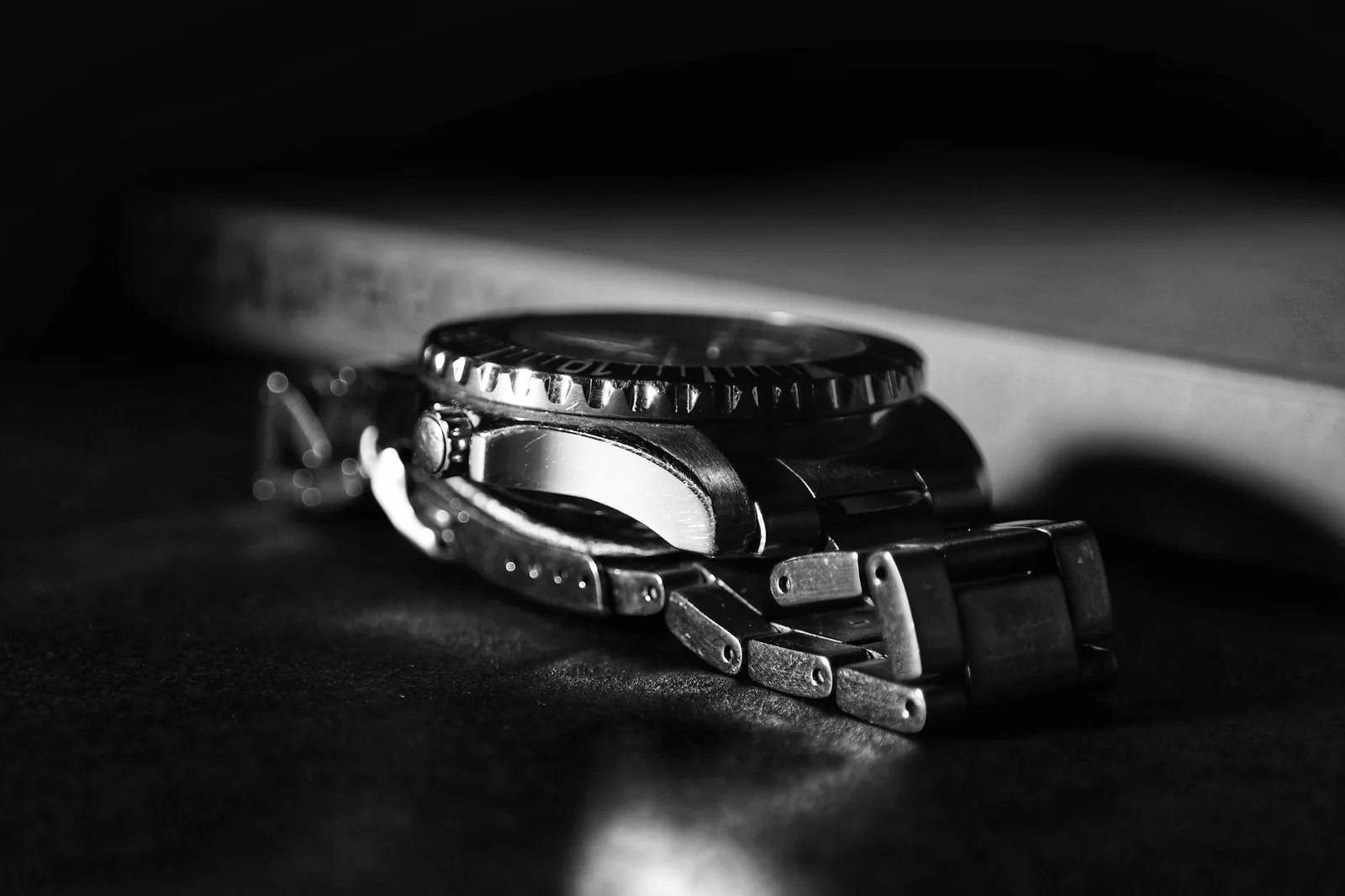
Lay the bracelet on a soft cloth with the inside facing up. Find the arrow on the link, then push the pin out in the direction the arrow points. Remove the link, join the bracelet back together and push the pin back in from the opposite side until it sits flush.
Citizen’s steps for its Simple Adjust bracelet, which uses a pin and a small coil spring, add three details:
- On bracelets with holes on both sides of the link, push out only the pin closest to the arrow, and leave the other one alone.
- Centre the pin when you refit it. Citizen says a pin that is not centred “could slip out while you are wearing the watch”.
- Keep the removed links, pins and springs somewhere safe. You will need them if you sell the watch or your wrist size changes.
Some makers use a split pin or a pin with a separate collar. Do not mix pins and collars between links, and if a pin will not move, stop rather than force it. The table sums up what makers’ own pages say.
| Adjustment type | How it changes length | Home job? | Source |
|---|---|---|---|
| Pin links (with spring or collar) | Push pins out along the arrow; remove links evenly | Often, with care | Citizen (2023); Longines |
| Screw links | Unscrew the bar; some have a screw at each end | Only with the right driver | Longines |
| Clasp micro-adjust holes | Move the spring bar in the clasp, about 2 mm per hole | Usually | Longines |
| Strap buckle | Buckle at or near the middle hole | Yes | Marathon |
| Ceramic links | As above, but links can crack | No: authorised service centre | Longines |
| Gold or vintage bracelets | As above | No: watchmaker | Longines |
Sources: Citizen, Simple Adjust instructions (file dated 2023); Longines, "How to remove links from a watch" (checked 29 October 2026); Marathon, "How to Measure Your Wrist Size" (checked 29 October 2026).
What is a “half link,” and do you need one?
A standard metal bracelet removes or adds length in whole-link steps, which on many bracelets works out at somewhere around 7 to 9mm per link. That is sometimes too coarse a step: take out one link and the bracelet is noticeably loose, leave it in and it is a little tight. A half link, sold by specialist suppliers such as Steel Reef as a precision-fit component for popular bracelet families including Rolex and Tudor, is built to roughly half the width of a standard link, letting you fine-tune the length between two whole-link sizes rather than being stuck between them (Steel Reef, half links and extension links, checked 29 October 2026). Separately, many metal clasps also include a small extension link fitted under the clasp itself, which several makers build to adjust in increments of around 5mm, covering the same kind of in-between sizing without needing a separate part ordered specially.
Not every bracelet has a half-link option, and fitting one on a bracelet not designed for it is a job for a jeweller or watchmaker rather than a home attempt, since it usually means sourcing a part that matches the specific bracelet’s link design and finish. If you are between two sizes on a standard pin bracelet, ask the seller or an authorised retailer whether a half link exists for your specific reference before assuming you have to compromise on the whole-link fit.
How do you adjust a watch strap or clasp without removing links?
Many metal clasps have small micro-adjust holes for the spring bar that holds the bracelet. Moving the bar one hole changes the length slightly; Longines puts it at roughly 2 mm. A leather or rubber strap is adjusted at the buckle, and Marathon suggests it should fasten at or near the middle hole.
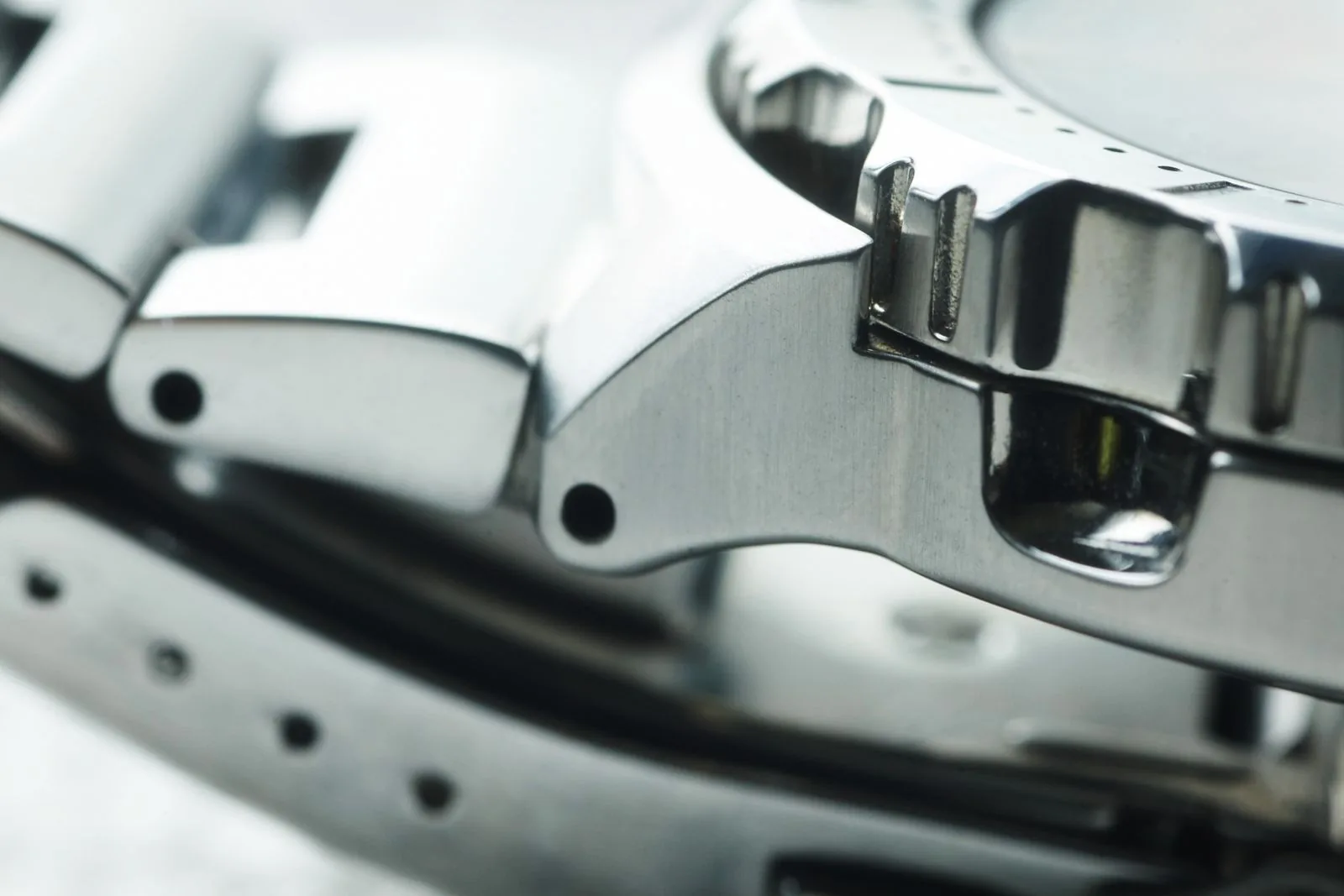
After moving a spring bar, check it has seated on both sides before you wear the watch. If a strap only fits on its last hole, a different strap length will fit better. If you plan to swim in the watch, Seiko advises against a leather strap even on a water-resistant watch; see what water resistance ratings mean.
This is distinct from swapping the strap or bracelet entirely for a different one, which some watches make tool-free through a quick-release spring bar: a small lever or tab on the underside of the strap that lets you unclip it from the lugs by hand and press a new one into place. Where a watch has this fitting, changing the whole strap is simpler than adjusting length within one strap, though it does not help with the core bracelet-link question above if what you actually need is a smaller or larger metal bracelet rather than a different strap. Not every watch has quick-release fittings; check before assuming you can swap straps without a standard spring-bar tool.
Some clasps build a larger, dedicated comfort extension into the clasp itself, rather than a set of small holes. Rolex calls its version Easylink, a rapid extension system patented in 1996 and concealed under the bracelet’s clasp, which Rolex says adjusts the bracelet’s length by about 5mm in a single motion: you unclip an extra link to lengthen the bracelet, or clip it back in to shorten it, without any tool (Rolex, Easylink, checked 29 October 2026). It is designed for small, everyday changes in fit, such as wrist swelling in heat, rather than as a substitute for having the bracelet correctly sized in the first place; a bracelet still has to be the right base length before the extension link has anything useful to add or take away.
How do you resize a mesh or Milanese bracelet?
A mesh or Milanese bracelet works on a different mechanism entirely, and most of the home-tool advice above does not apply to it. Rather than separate links joined by pins, the bracelet is a continuous woven mesh that slides through a sliding clasp; to adjust it, you lift the clasp slightly away from the mesh, slide it to the new length along the weave, and press it back down to lock it in place, as a watch strap retailer’s own adjustment guide describes (Charlie Paris, “How to adjust a Milanese mesh watch strap?”, checked 29 October 2026). The same guide says a dedicated strap-adjustment tool makes lifting the clasp easier and cleaner, though it notes that something as simple as a toothpick can work if you do not have one, inserted through the clasp’s slot to raise it just enough to slide.
Because nothing is permanently removed, a mesh bracelet can usually be lengthened or shortened again later in seconds, with no spare parts to lose and no risk of the pin-and-link mismatches covered above. The main risk is cosmetic: forcing the clasp with something sharp-edged, rather than a smooth tool or toothpick, can scratch the finish of the clasp or the mesh underneath it, so take the same care you would with any polished surface.
When should a jeweller or watchmaker do it instead?
Hand the job over if the bracelet uses screws you cannot turn cleanly, has ceramic or precious-metal links, is vintage, or the watch is still under a maker’s or dealer’s warranty. Also stop if a pin will not move or you are unsure which pin to push. Citizen’s instructions say to return the watch to the retailer “if you experience any difficulty whatsoever”.
Seiko’s UK pages recommend having a strap adjusted at an authorised Seiko service centre or appointed dealer (Seiko UK, checked October 2026). Longines advises leaving ceramic links to an authorised service centre and gold or vintage bracelets to a watchmaker. A slipped tool on a polished link leaves a mark a future buyer will see; condition grades explain how such wear is described. If you are buying from a dealer, ask whether they will size the bracelet before dispatch, one of the differences covered in private seller or dealer.
A slipped pin pusher or screwdriver is also one of the more avoidable sources of damage to resale value, precisely because it happens at a stage the watch has otherwise survived undamaged. A tool mark on a lug-side link, right where a future buyer’s eye naturally lands, can be more noticeable and harder to disguise than a general scuff elsewhere on the case, since it sits on a flat, usually polished surface with nothing else to distract from it. If you are at all unsure of your grip or the tool’s fit on a watch you plan to sell on later, that is itself a reason to pay a jeweller a modest fee rather than risk a mark that costs more to fix, or more in a lower sale price, than the job would have cost in the first place.
Can resizing a bracelet yourself affect the warranty?
It can. Seiko’s UK warranty FAQ says repairs are charged, even within the warranty period, for damage caused by repairs carried out by anyone outside its service network. Longines states that damage to lugs, links or clasp during home adjustment is treated as misuse. Read your warranty before picking up a pin pusher.
Seiko also says that, even under warranty, band adjustment is charged at stores other than the one where you bought the watch. A dealer’s own warranty on a pre-owned watch may carry its own exclusions, so check the wording or ask. Watch warranty explained covers how maker and dealer cover differ.
Keep the spare links with the box and papers. They are part of what a buyer expects in a full set.
What if you lose a link, or your wrist size changes again?
A lost link usually means ordering a replacement rather than improvising with a different one, because links are made to match a specific bracelet reference, finish and sometimes production batch; a link that is close but not identical can leave a visible mismatch in polish, width or even colour on a two-tone or precious-metal bracelet. Ask the brand’s own customer service or an authorised retailer first, quoting the bracelet reference, since this is one area where going outside the authorised network for a part risks a finish that does not quite match, which condition grades explained notes buyers do pick up on later.
Wrists also change over time, through weight change, age, or simply the seasons, and a bracelet fitted snugly one year can feel different the next. Rather than assuming you need to remove more links every time it feels loose, check whether the clasp has a micro-adjust or a comfort extension first, since these are built for exactly this kind of small, repeated adjustment without permanently altering the bracelet’s length. If you do need to add links back in, keep any you removed previously rather than buying new ones, both for cost and because they are guaranteed to match.
Frequently asked questions
Which way do I push a watch bracelet pin?
In the direction of the arrow engraved on the inside of the link. Refit it from the other side.
How many links should I remove?
As few as you need for a one-finger gap. Take them evenly from both sides of the clasp, as Citizen’s instructions describe.
Can I use a paper clip to remove watch links?
Citizen’s instructions for one of its bracelets use a bent paper clip. Other bracelets need a proper pin pusher or screwdriver, so check your maker’s guidance first.
What if the pin will not come out?
Stop. Citizen suggests flexing the joint a few times and trying again; if it still sticks, take it to a jeweller rather than forcing it.
How do I adjust a bracelet by a few millimetres?
Use the micro-adjust holes in the clasp, if it has them. Longines puts each step at about 2 mm.
Should I keep the links I remove?
Yes. Keep them with the pins and the box. You will need them if your wrist changes or you sell the watch.
Will resizing my watch myself void the warranty?
Possibly. Seiko and Longines both exclude damage from adjustment done outside their service network, so check your terms first.
Can a jeweller resize any watch bracelet?
Most jewellers can resize a standard pin or screw bracelet. For ceramic, precious-metal or vintage bracelets, Longines advises an authorised service centre or a watchmaker.
How do I adjust a leather watch strap?
Use the buckle holes. If you can only fasten it on the first or last hole, a different strap length will fit better.
What is a half link used for?
Fine-tuning a metal bracelet between two whole-link sizes, when removing a full link leaves it too loose but keeping it in leaves it a little tight. Not every bracelet has one available; ask the retailer for your specific reference.
Can I resize a Milanese or mesh bracelet at home?
Usually, yes, and more easily than a pin bracelet. Lift the sliding clasp away from the mesh with a strap tool or something like a toothpick, slide it to the new length, and press it back down. Nothing is permanently removed, so it can be adjusted again later.
What if I lose a link from my bracelet?
Order a replacement that matches the exact bracelet reference and finish, ideally from the brand or an authorised retailer, rather than a close but non-matching substitute, which can show as a visible mismatch later.
This page is general information, not professional advice.
Sources (checked 29 October 2026)
- Citizen, Simple Adjust bracelet instructions (PDF, file dated 2023)
- Longines, How to remove links from a watch (undated; read through an automated summary because the page refused direct download)
- Seiko UK, Where can I have my watch strap adjusted?
- Seiko UK, What is warranted during the warranty period? and How should I care for my watch band?
- Marathon, How to Measure Your Wrist Size (undated)
- Rolex, Easylink
- Steel Reef, half links and extension links
- Charlie Paris, “How to adjust a Milanese mesh watch strap?”
We check the facts in this guide against the sources named, and it is correct to the best of our knowledge as of October 2026. Rules, rates and sellers' terms change, so confirm the details with the seller, or with a professional, before you buy.