Watch60 is independent and not affiliated with any watch brand or retailer.
Watch water resistance explained in one line: the marking on the case is a test pressure, not a depth you can safely reach. Makers’ own charts say a watch marked 3 bar or 30 m is for splashes and rain only, 5 bar or 50 m is the usual minimum for swimming, and scuba diving needs a watch sold as a divers’ watch. Seals age, so a pre-owned watch should be tested before it gets wet.
Water resistance is a watch’s ability to keep water out under set test conditions. It is not the same as waterproof, and it is not permanent. This guide is general information. Your watch’s manual and the maker’s guidance override it.
What does watch water resistance mean?
It means the watch met a water resistance test at a stated pressure when it was made. The marking, in bar, atmospheres (atm) or metres, shows that level. It is not a safe depth for real use, and it does not last for ever, because the rubber seals inside the case age.
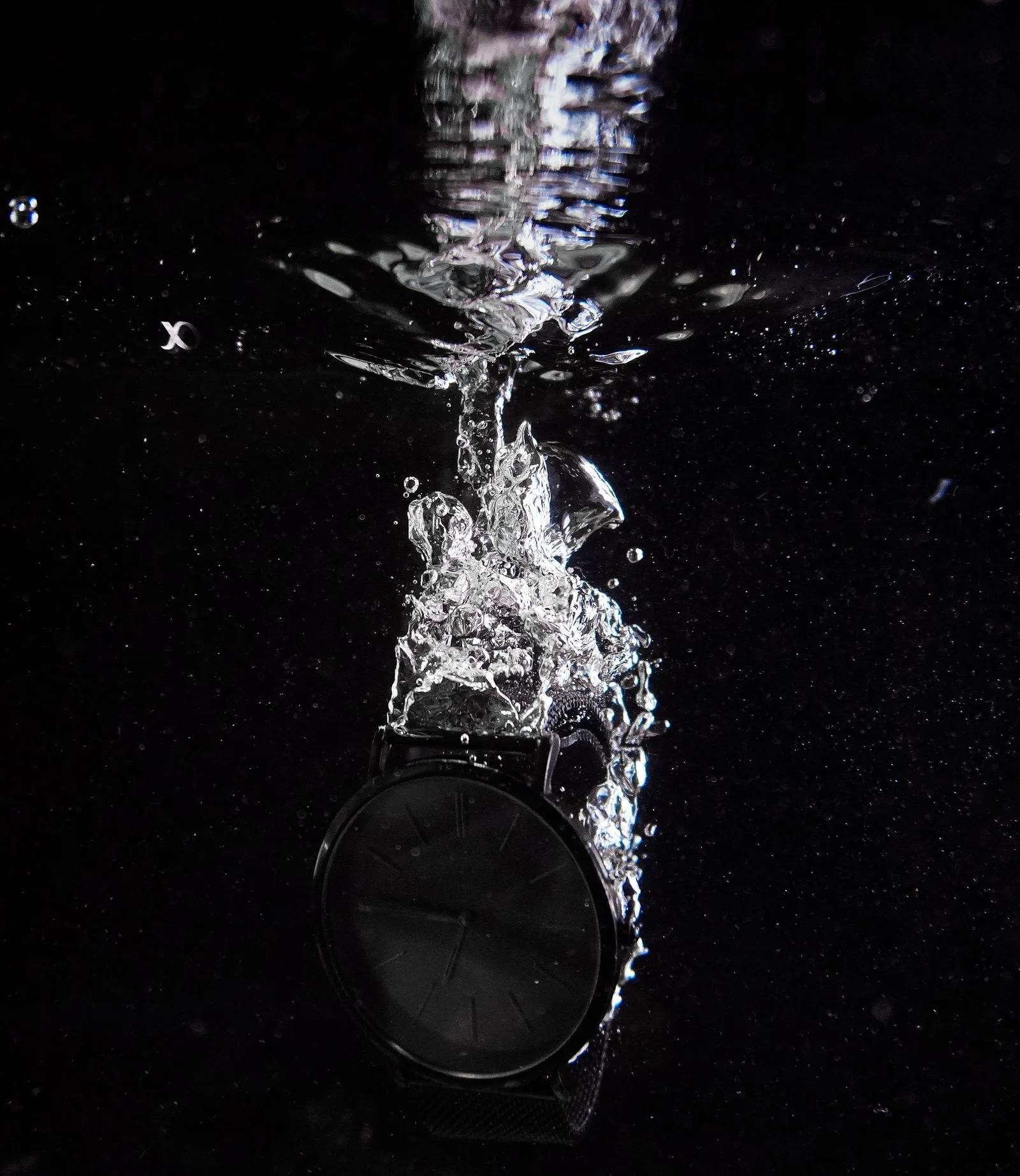
Citizen notes that 1 bar is roughly equal to one atmosphere, and that “W.R.”, “WATER RESIST” and “WATER RESISTANT” all mean the same thing on a case (Citizen, checked October 2026). A watch with no marking at all, Citizen says, is not designed to come into contact with any moisture. A metre figure and a bar figure describe the same rating, with 10 m treated as about 1 bar.
The standard for ordinary water-resistant watches is ISO 22810:2010, Horology: Water-resistant watches. Its published scope says it sets the requirements and test methods used to verify a watch’s water resistance, and the marking a maker may apply.
30m vs 50m vs 100m: what is the difference?
The difference is what the maker says you can do while wearing the watch. On Seiko’s and Citizen’s published charts, 30 m (3 bar) covers splashes and rain, 50 m (5 bar) adds swimming, and 100 m (10 bar) adds skin diving or shallow diving. None of the three is rated for scuba diving.
The table condenses the two makers’ charts. Others may differ, so check yours.
| Marking | Seiko UK says it allows | Citizen says it allows | Both say not for |
|---|---|---|---|
| No marking | Nothing listed | No contact with moisture | Any water |
| 3 bar / 30 m | Accidental splashes, rain | Occasional splashing; washing face, rain | Swimming |
| 5 bar / 50 m | Adds swimming, yachting, taking a shower | Adds swimming, general washing work | Skin diving |
| 10 bar / 100 m | Adds bathing and shallow diving | Adds skin diving, marine sports | Scuba diving |
| 15 or 20 bar / 150–200 m | Same as 10 bar | 20 bar: same as 10 bar | Scuba diving |
| Diver’s 200 m | Adds scuba diving | Scuba diving with an air tank | Saturation diving with helium |
| Professional diver’s 1,000 m (Seiko) | Adds saturation diving | Not on Citizen’s chart | — |
Sources: Seiko UK, "Water Resistance" customer service table; Citizen, water resistance warning and performance table (both checked 29 October 2026).
Both makers also say not to use the crown while the watch is wet, whatever the rating. Citizen’s table adds the buttons.
Is my watch safe to swim in?
Only if it is rated at least 5 bar or 50 m, its seals are in good condition, and the crown is pushed or screwed fully home. Both Seiko and Citizen list 3 bar or 30 m watches as unsuitable for swimming. For a pre-owned watch, have the water resistance tested first, because the original rating assumed new seals.
Seiko’s UK pages say that water resistance “is not permanently guaranteed” and is affected by the ageing of gaskets, the rubber seals in the case, and by deformation from knocks (Seiko UK, checked October 2026). It recommends having water resistance checked regularly. If a seller cannot say when it was last tested, assume it needs doing; see caring for a mechanical watch.
The strap matters too. Seiko advises against wearing a leather strap for bathing, swimming or work with water, even when the watch itself is water-resistant.
What makes a divers’ watch different?
A divers’ watch is a watch made for diving, and it has its own standard, ISO 6425:2018, Horology: Divers’ watches. Its published scope says it applies to watches designed to withstand diving to at least 100 m and fitted with a “secured measuring system to indicate the diving time, which is visible in darkness” (ISO 6425:2018 scope, as reproduced by the Estonian Centre for Standardisation).
The same standard has an annex for watches used in saturation diving, and it sets out the markings a maker may apply. A high metre figure on its own does not make a watch a divers’ watch. If you plan to scuba dive, ask the seller or the maker whether the watch was sold as a divers’ watch and tested to ISO 6425, and keep the answer in writing.
Why does ISO 6425 test more than just pressure?
A specialist account of the standard’s testing (hourstriker.com, checked 29 October 2026) notes that ISO 6425 goes beyond a simple pressure soak. As well as holding the stated pressure, it tests at 125% of the rated pressure, runs a condensation test to check the crystal does not mist up inside, puts the watch through a thermal shock test moving between hot and cold water, and checks the crown, pushers and strap or bracelet attachments can withstand an external force without the case losing its seal. An ordinary water-resistant watch tested only to ISO 22810 is not put through this wider set of checks, which is one practical reason a watch rated 100 m under ISO 22810 is not simply an easier-to-get version of a 100 m divers’ watch tested to ISO 6425; the two standards are testing for different things.
What is a helium escape valve, and do you need one?
A helium escape valve is a one-way valve, fitted to some divers’ watches, that releases helium gas which has worked its way into the case during long periods inside a pressurised, helium-rich atmosphere, of the kind used in saturation diving and diving-bell work. During decompression after this kind of dive, trapped helium inside the case can expand faster than it can escape through the normal seals, and without a valve to vent it, the pressure build-up can force the crystal off the case (based on the mechanism Oris describes for its own watches, checked 29 October 2026). The valve should only be operated out of the water, and some modern versions open automatically rather than needing to be turned by hand.
For context, Rolex’s own Sea-Dweller carries a helium escape valve and a published rating of 1,220 m, developed because the Submariner’s rating at the time, 200 m, was not enough for the commercial divers Rolex and COMEX were working with; the Deepsea variant goes further still, to 3,900 m (Wikipedia, drawing on Rolex’s own published history, checked 29 October 2026). For almost all buyers, the relevant point is simpler than the headline depth figures: a helium escape valve matters only for saturation diving, not recreational scuba diving, swimming or everyday wear, so its presence or absence should not be a deciding factor unless that is genuinely what the watch is for.
Does water resistance wear off over time?
Yes. Seiko says water resistance is affected by the ageing of the gaskets and by parts bent out of shape in a knock, and that worn gaskets can let rust or moisture into the movement. It recommends regular water resistance checks and servicing about every three years for its own watches.

For a buyer, the age of the seals matters more than the number on the caseback. Condition grades describe the outside, not the gaskets. Ask when the watch was last serviced and whether that included a pressure test. Cover for water damage depends on the terms; see watch warranty explained.
How does a watchmaker actually test water resistance?
A specialist explanation of the process (hourstriker.com, checked 29 October 2026) describes water resistance ratings as being established through static, or hydrostatic, pressure testing in a controlled setting: a sample watch is held at the rated pressure for a short period, which is why a rating describes a tested condition, not a guaranteed real-world depth. Two broad approaches are used in watchmakers’ workshops:
- A dry test uses a pressure chamber and a sensor to check whether the case holds its air pressure without ever exposing the watch to water, so there is no risk of water reaching the movement if a seal has failed. This is the test most independent watchmakers can offer quickly and without opening the case.
- A wet test submerges the watch and checks for bubbles or condensation, which shows a seal has already failed rather than predicting one that is about to.
The same source explains that the seals doing the actual work are elastomeric gaskets, fitted at the crystal-to-case joint, the caseback, and the crown and pusher openings; common materials include nitrile, Viton and silicone. A screw-down crown adds a second line of defence by compressing its own gasket when tightened, independent of the stem’s seals. These gaskets degrade with UV light, temperature swings and exposure to chlorine, salt water and soap, hardening and cracking over time, which is the physical reason behind Seiko’s advice, above, that water resistance needs checking regularly rather than being assumed from the number on the dial.
A practical consequence for pre-owned buyers: any time a case has been opened, for a battery change, a strap swap that disturbs the caseback, or a service, the gaskets inside have been disturbed and should be retested before you rely on the watch’s rating again. A seller who can show a dated pressure-test result from after the last time the case was opened is giving you more useful information than the metre figure engraved on the back.
How do brand ratings compare at the models buyers actually ask about?
Manufacturers set their own ratings model by model, so two divers’ watches from different brands at a similar price are not always rated the same. A few named examples, to illustrate the range rather than to recommend any one watch:
| Model | Published rating | What it tells you |
|---|---|---|
| A typical dress watch (various brands) | 30–50 m | Splashes and light rain only on the lower figure; brief swimming only once at 50 m, per Seiko’s and Citizen’s charts above |
| Rolex Submariner | 300 m | A divers’ watch tested to ISO 6425, well beyond recreational diving needs |
| Rolex Sea-Dweller | 1,220 m, with a helium escape valve | Built for the commercial, saturation-diving work the Submariner’s original 200 m rating could not cover (Wikipedia, drawing on Rolex’s published history) |
| Rolex Deepsea | 3,900 m | A specialist, extreme-depth variant of the Sea-Dweller family |
Sources: Seiko UK and Citizen charts as cited above; Wikipedia's Rolex Sea-Dweller entry, drawing on Rolex's own published model history (checked 29 October 2026).
The point for a buyer is not to chase the highest number. A 300 m divers’ watch and a 1,220 m saturation-diving watch will behave identically for swimming, snorkelling or recreational scuba diving; the extra rating on the second buys capability most owners will never use, at the cost of a bulkier case and, usually, a higher price.
What should you avoid with a water-resistant watch?
Avoid using the crown while the watch is wet, wearing it in a hot bath or sauna, and rinsing it under a running tap. After sea water, rinse it in still fresh water and dry it. Keep a screw-down crown fully screwed in. These come from Seiko’s and Citizen’s care pages.
Seiko says tap pressure is enough to force moisture inside, and that steam, soap and hot-spring water speed up the loss of water resistance. Its chart lists showers under 5 bar while its care page warns against running water, so treat showers with caution. Citizen advises against wearing a watch in a sauna because of the risk of burns.
Definitions of terms such as “screw-down crown” and “gasket” are in the watch terms glossary.
What should you do if you see moisture inside the crystal?
Misting on the inside of the crystal, or visible droplets under the glass, means water or condensation has already got past the seals, and leaving it is how a damp movement becomes a rusted one. Stop wearing the watch, do not try to dry it with heat such as a hairdryer or on a radiator, which can push moisture further into the movement, and take it to a watchmaker as soon as you reasonably can rather than waiting to see if it clears on its own. The longer moisture sits against steel parts inside the movement, the more likely it causes lasting corrosion rather than a problem a timely strip-and-dry service can put right.
If the watch is still under warranty, check whether water ingress is covered before you pay for a repair yourself; watch warranty explained sets out what is typically included and excluded.
Frequently asked questions
Can I swim with a 30m water-resistant watch?
Not according to Seiko’s and Citizen’s charts, which list 3 bar or 30 m as suitable for splashes and rain only.
Is a 50m watch OK for swimming?
Both makers’ charts allow swimming at 5 bar or 50 m, as long as the seals are sound and the crown is closed.
What is the difference between 100m and 200m water resistance?
On Seiko’s and Citizen’s charts, 10 bar and 20 bar watches are rated for the same activities. Neither is rated for scuba diving unless it is sold as a divers’ watch.
Can I wear my watch in the shower?
Be careful. Seiko’s chart lists showers under 5 bar, but its care advice warns about tap pressure, soap and steam.
Is a water-resistant watch waterproof?
No. Seiko says water resistance “is not permanently guaranteed”, because the seals age and need checking.
How often should water resistance be checked?
Seiko recommends regular checks and servicing about every three years for its watches. Follow your own maker’s interval.
Should I test a pre-owned watch before swimming?
Yes. The rating applied when the watch was new, so ask a watchmaker to pressure test it first.
What is ISO 6425?
The international standard for divers’ watches. It applies to watches with at least 100 m water resistance that meet extra requirements, such as a secured way to show diving time and a timing display visible in the dark.
Why does a dive watch need more testing than an ordinary water-resistant watch?
Because ISO 6425 tests more than pressure alone. It adds testing at 125% of the rated pressure, a condensation check, thermal shock between hot and cold water, and checks that the crown, pushers and strap attachments hold under an external force, none of which an ordinary ISO 22810 water-resistant watch is tested against.
What does a helium escape valve actually do?
It vents helium gas that has built up inside the case during long saturation dives, so the pressure does not force the crystal off during decompression. It only matters for saturation and commercial diving; recreational divers and swimmers have no practical use for one.
What should I do if my watch gets water inside the crystal?
Stop wearing it, don’t apply heat to dry it out, and get it to a watchmaker promptly. Moisture left sitting against the movement’s steel parts is more likely to cause lasting corrosion than a problem caught and dried out quickly.
This page is general information, not professional advice.
Sources (checked 29 October 2026)
- ISO, ISO 22810:2010 Horology: Water-resistant watches (2010; page refused automated access). Scope as reproduced by the Estonian Centre for Standardisation
- ISO, ISO 6425:2018 Horology: Divers’ watches (2018; page refused automated access). Scope as reproduced by the Estonian Centre for Standardisation
- Seiko UK, Water Resistance (chart and cautions)
- Seiko UK, What special care should I give my watch? and Why does Seiko recommend servicing your watch about every three years?
- Seiko UK, How should I care for my watch band?
- Citizen, Water resistance warning and water resistance performance table
- Citizen, Precautionary items and usage limitations
- Hourstriker, engineering watch water resistance: seals and pressure dynamics (testing methods, gasket materials, ISO 6425 detail)
- Oris, what does a helium escape valve do
- Wikipedia, Rolex Sea-Dweller (model ratings, drawing on Rolex’s published history)
We check the facts in this guide against the sources named, and it is correct to the best of our knowledge as of October 2026. Rules, rates and sellers' terms change, so confirm the details with the seller, or with a professional, before you buy.