Who are Bovet?
Bovet is a Swiss maker of high-complication watches. It was founded in 1822 by Édouard Bovet and his brothers, watchmakers from Fleurier, to make watches for the Chinese market (Bovet). The company today, Bovet Fleurier S.A., makes its movements in Tramelan and finishes and cases them at the Château de Môtiers (Bovet). This page covers its history, collections and ownership, then what to check when buying a second-hand Bovet in the UK.
Bovet says it makes more than 95% of its watch components itself and around 1,000 timepieces a year; Wikipedia gives a lower figure of about 800. Sources also differ on the headquarters: Bovet gives its registered address as Fleurier, while Wikipedia names Geneva.
The history of Bovet
Bovet’s history falls into two parts: a 19th-century business selling decorated pocket watches in China, and a modern company built after Pascal Raffy bought the name in 2001. In between, the name changed hands many times.
London and Canton. Bovet says Édouard, Alphonse and Frédéric Bovet left Fleurier for London in 1814 to work for Magniac & Co., and that in 1818 the firm sent Édouard to Canton (Guangzhou), where he arrived with four pocket watches. The brothers founded their own house in 1822, registered in London on 1 May (Bovet). A Sotheby’s catalogue note on a Bovet lot gives a similar account: Edouard worked in Canton while his brothers Frédéric and Alphonse ran the London side and a fourth brother, Gustave, worked from Fleurier, and it says the business prospered to the point that “Bovet” became almost synonymous with “watch” for Chinese buyers (Sotheby’s). Wikipedia says the brothers in London handled shipping while Charles-Henri Bovet ran manufacturing in Fleurier, and that the company opened a workshop in Canton in the 1830s, later moving to a smaller site in Macau because of the Opium Wars. Bovet describes its early pieces as highly decorated pocket watches using enamel miniature painting, cloisonné and guilloché, and Wikipedia says they were among the first to show their movements and to include a seconds hand.
Fleurier and Môtiers. The family bought the Château de Môtiers in 1835 (Bovet). At the 1855 Paris Universal Exhibition, Bovet won a gold medal for a pair of watches commissioned by the Xianfeng Emperor, and in 1889 it developed a flyback chronograph whose two subdials could show a second time zone (Bovet).
A century of owners. Wikipedia says the Chinese market collapsed around 1855 and that by 1864 the family had sold its interest to two Fleurier watch inspectors. Landry Frères bought the company in 1888, Jacques Ullmann & Co. in 1918, and Albert and Jean Bovet took the name back after Ullmann closed in 1932 (Wikipedia). Bovet says it patented an Easel Chronometer in the 1930s and created a mono-pusher chronograph in the 1940s; Wikipedia says its chronographs of this period used Valjoux and Landeron movements. Favre-Leuba bought the name in 1948 and stopped Bovet-branded watches in 1950, then sold the brand in 1966 to a cooperative of watchmakers (Wikipedia).
Revival. Parmigiani Fleurier bought the brand in 1989 without making any Bovet watches, and sold it in 1990 to investors who formed Bovet Fleurier SA. Roger Guye and Thierry Oulevay acquired the company in 1994 and began production again (Wikipedia).
Pascal Raffy. Raffy, a collector, acquired Bovet in 2001; Wikipedia gives the date as 6 February 2001. In 2006 he bought a tourbillon manufacture in Tramelan whose owner was retiring, and the canton of Neuchâtel invited him to acquire the Château de Môtiers, which it had owned since 1957 (Bovet). Wikipedia says the Tramelan business had been the STT group and was renamed Dimier 1738. Bovet says it has won more than 70 international awards since 2006, including the highest distinction at the Grand Prix d’Horlogerie de Genève in 2018 for the Récital 22 Grand Récital.
What is Bovet known for?
Bovet is known for its convertible Amadéo case, for pocket-watch styling with the crown at 12 o’clock, for tourbillons and other complications, and for hand-decorated dials.
The Amadéo case. Bovet’s patented Amadéo case turns one watch into a wristwatch that can be worn either way round, a pocket watch or a desk clock, without tools (Bovet). Monochrome describes how it works: concealed push-pieces release the straps, and a hinged bezel folds out as a stand. Many Amadéo watches have a dial on each side.
Pocket-watch styling. The Fleurier collection keeps the bow and crown at 12 o’clock, a nod to the pocket watches Bovet made in the 19th century (Bovet).
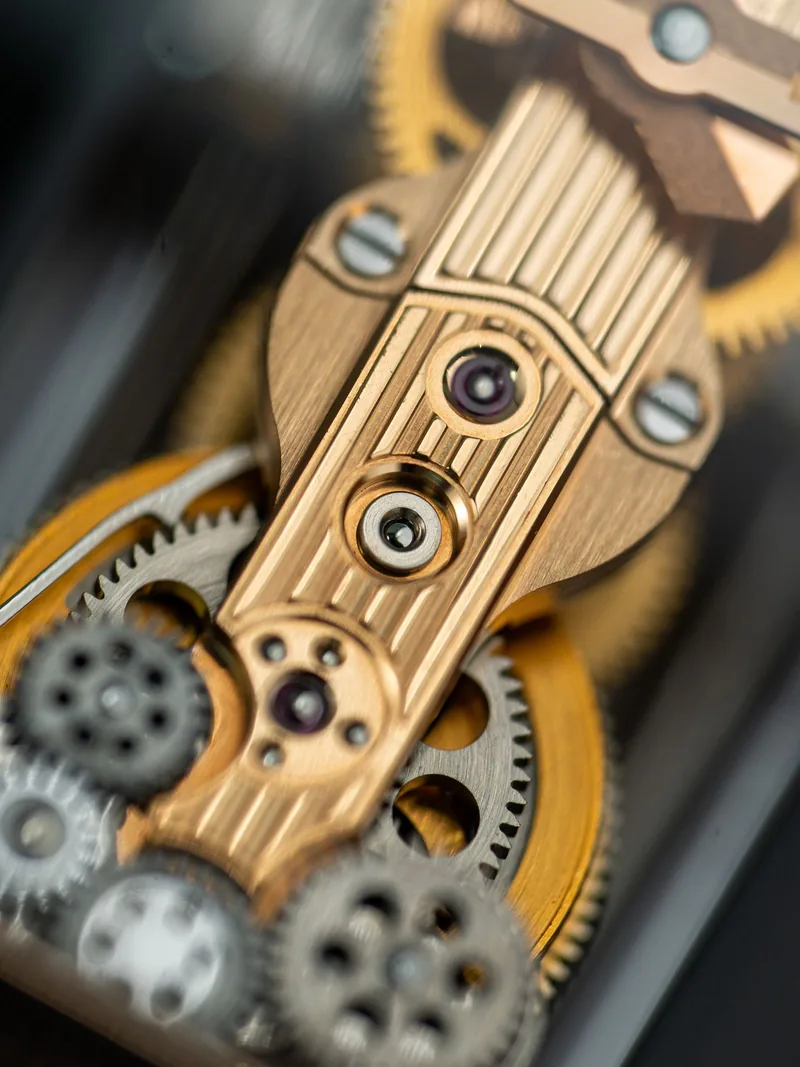
Movements. Bovet says it has designed 59 calibres since 2006 and makes its own hairsprings, escapements and regulating organs; sapphire crystals, straps, synthetic rubies and mainsprings come from outside. Wikipedia says some modern movements have come from Vaucher Manufacture, and that a seven-day tourbillon is Bovet’s signature complication. Our guide to in-house and outsourced movements explains why this matters when you buy. De Bethune, another small independent manufacture based nearby in the Jura, takes a similarly hands-on approach to finishing and complications.
Decoration. Wikipedia says Bovet is known for its dials, such as miniature painting, and for engraving, and that about a third of its watches are one-of-a-kind pieces made to order.
Which Bovet collections are there?
Bovet’s current range is split into two collections: Fleurier, with the crown at 12 o’clock, and Dimier, with the crown at 3 o’clock. Bespoke watches are made through Les Ateliers Bovet (Bovet).
The collections table on this page gives a line on each. A few points help when you read listings:
- Fleurier families. Fleurier includes Virtuoso, Monsieur Bovet, 19Thirty, Amadéo Tourbillon, Battista Tourbillon, Orbis Mundi, Aperto and Miss Audrey (Bovet). Read the full model name and reference, not just “Fleurier”.
- Dimier and Récital. The Dimier collection is currently made up of numbered Récital models, from Récital 12 to Récital 32, and holds Bovet’s highest complications in its Writing Desk case (Bovet).
- Unique pieces. Because many Bovet watches are one-offs or very small series (Wikipedia), a listing may not match any catalogue photograph. Ask for the reference and the papers.
- Earlier watches. Bovet watches made between 1994 and 2001, and vintage Bovet chronographs from the 1930s to the 1950s, come from different owners and eras (Wikipedia), so treat them as different purchases from a modern Bovet.
Who owns Bovet?
Bovet is privately owned by Pascal Raffy, who acquired the house in 2001 and is its sole owner and chief executive (Bovet). The company is Bovet Fleurier S.A., with a registered address on Avenue Daniel-Jeanrichard in Fleurier (Bovet). It is not part of a watch group.
Buying a Bovet watch second-hand in the UK: what to check
Check the papers and reference, test every function of an Amadéo case, ask about servicing and the warranty, and run a stolen-watch check.
1. Papers and the full set. With so many unique and small-series pieces, the warranty card and invoice are the main record of what the watch is. Bovet’s own customer service asks owners for the invoice, warranty card and a photograph of the case back (Bovet). Our guide to what “full set” means explains what each item proves.
2. The Amadéo case. On a convertible watch, ask the seller to show every mode: both sides on the wrist, the pocket-watch bow and the desk-clock stand. Check that the push-pieces release cleanly and that both dials work.
3. Condition. Painted, engraved and enamelled dials cannot simply be replaced like a printed dial, so look closely at them and at a hinged bezel for wear. Our guide to condition grades explains how sellers describe wear.
4. Servicing. Ask when the watch was last serviced, by whom, and for the paperwork. Bovet’s after-sales team is based at the Château de Môtiers (Bovet). Tourbillons and other complications need a watchmaker with the right experience; our guide on how to care for a mechanical watch covers what a service involves.
5. Warranty. Bovet’s website did not show its warranty terms when we checked. See watch warranties explained.
6. Authenticity and theft. Buy from a seller who will put authenticity in writing and accept returns, and have the watch checked by a watchmaker you choose. Our guide on how to spot a fake watch covers what a watchmaker looks at, and our stolen-watch check guide lists the UK registers to search before you pay.
For the full process from setting a budget to collecting the watch, see the guide to buying a luxury watch.
Frequently asked questions
Who owns Bovet?
Pascal Raffy, who acquired the house in 2001 and is its sole owner and chief executive (Bovet).
When was Bovet founded?
In 1822, by Édouard Bovet and his brothers. The house was registered in London on 1 May 1822 (Bovet).
Why did Bovet make watches for China?
Édouard Bovet went to Canton in 1818 for Magniac & Co., and the brothers founded Bovet to make watches for the Chinese market (Bovet; Wikipedia).
Where are Bovet watches made?
Movements and many components are made in Tramelan, and final assembly, casing and checks take place at the Château de Môtiers (Bovet).
What is the Bovet Amadéo case?
A patented convertible case that lets one watch be worn as a wristwatch on either side, carried as a pocket watch or stood as a desk clock, without tools (Bovet).
Why is the crown at 12 o’clock on some Bovet watches?
The Fleurier collection keeps the bow and crown at 12 o’clock as a tribute to Bovet’s pocket watches; the Dimier collection has the crown at 3 o’clock (Bovet).
Does Bovet make its own movements?
Yes. Bovet says it has designed 59 calibres since 2006 and makes more than 95% of its components (Bovet).
Is Bovet related to Parmigiani Fleurier?
Only briefly: Parmigiani Fleurier owned the brand from 1989 to 1990 but made no Bovet watches (Wikipedia).
This page is general information. Watch60 is independent and has no commercial relationship with Bovet.
Sources (checked 29 October 2026)
- Bovet, house of Bovet, history, manufacture, the castle, customer service and collection pages for all collections, Fleurier, Dimier and Monsieur Bovet
- Wikipedia, Bovet Fleurier
- Monochrome, Bovet Monsieur Bovet: wristwatch, pocket watch and desk clock at once (1 May 2018)
- Sotheby’s, Important Watches, Geneva, lot 308 (2013 catalogue note on a Bovet pocket watch)
We check the facts on this page against the sources listed, and it is correct to the best of our knowledge as of October 2026. Brands change their warranty, servicing and sales terms, so confirm them with the brand or the seller before you buy.