When buying a watch as a gift, settle four things before you pay: the size, whether you will engrave it, who can return it, and whose name goes on the warranty. The law gives most consumer rights to the person who bought the watch, not the person who receives it, so a little planning at the till saves problems later. This guide covers each step for UK buyers.
A gift receipt is a receipt without the price that some sellers issue, so the recipient can use the seller’s own returns or exchange policy. It does not create legal rights of its own. This guide is general information, not legal advice.
What should you know before buying a watch as a gift?
Know the recipient’s wrist size or a watch they already wear, the seller’s returns policy for unwanted items, and whether the seller will note on the order that the watch is a gift. Ask how the warranty is registered and how the watch will be sent. Decide on engraving last, because it can remove your right to cancel.
The order matters. Size and style decide whether the watch gets worn. Returns, warranty and delivery decide what happens if it does not.
How do you get the size right without asking?
Borrow a watch they already wear comfortably and note its case diameter and lug-to-lug length, which are usually on the maker’s website or in its listing. Choose a case close to those figures. For the bracelet, measure the inside length of the closed bracelet, or a strap’s worn hole, with a soft tape.
A metal bracelet can usually be adjusted by adding or removing links, so ask the seller to include any spare links with the watch. The steps are in how to resize a watch bracelet. Case measurements, and how they relate to wrist size, are explained in our watch sizing guide.
How do you choose a style they will wear?
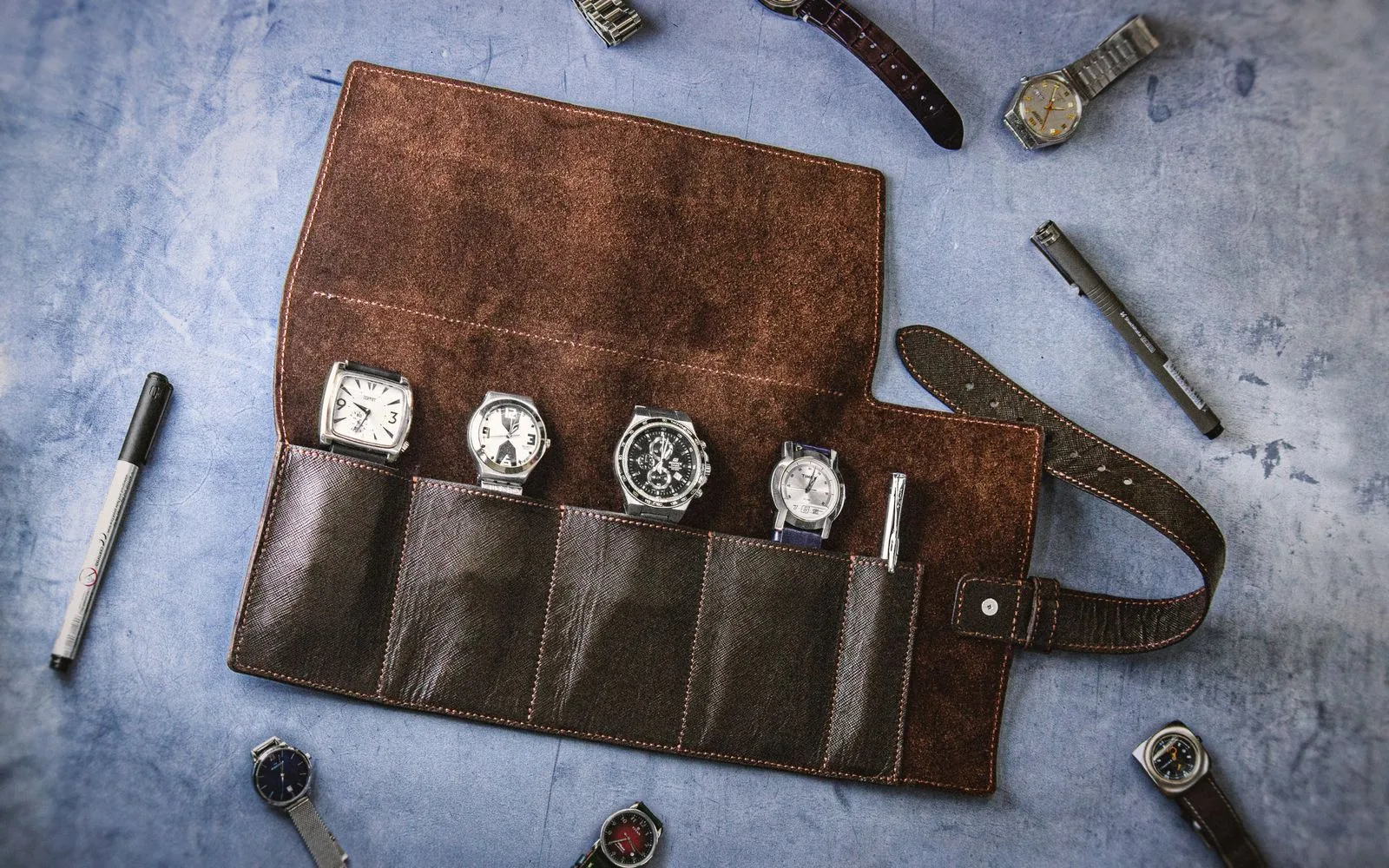
Look at what they wear now. Metal colour, dial colour, bracelet or strap, and how dressy their current watch is all tell you more than a guess. If everything they own is on a leather strap, a chunky steel sports watch is a risk. If they have no watch at all, a plain, versatile design is the safer choice.
Think about their day too. Someone who swims or works with their hands needs a different watch from someone who wears one only to dinner. Movement type also affects ownership: an automatic needs wearing or a winder, a quartz watch needs a battery. The differences are set out in mechanical versus quartz.
What about buying a first watch for a child or teenager?
The usual rules still apply, but the margins for error are smaller in two ways. First, a child’s or young teenager’s wrist is still growing, so buy with more spare adjustment than you would for an adult, and favour a bracelet or strap that is easy to resize again later rather than one fitted to the exact measurement today; see how to resize a watch bracelet for what a seller can usually take in or let out. Second, a first watch is as much about building a habit of wearing one as about the watch itself, so a simpler, more affordable case and movement that can take a few knocks is usually a better choice than something precious, which argues for a lower price band than you might otherwise consider for the same recipient’s age.
If the watch is quartz rather than mechanical, as many first watches are, a battery swap is the only routine upkeep it needs for years, which removes winding and servicing from the list of things a young owner has to think about. If you do choose a mechanical watch to mark something specific, such as a first job, treat the warranty-registration and papers steps below as even more important, since a young owner is less likely to have kept them carefully by the time the watch needs its first service.
Does engraving affect your right to return a watch?
It can. For online and other distance purchases, the Consumer Contracts Regulations 2013 normally give you 14 days to cancel, but regulation 28(1)(b) excludes goods that are made to the consumer’s specifications or are clearly personalised. A watch engraved to your order is likely to fall within that exclusion.
The exclusion covers cancelling because you changed your mind. A faulty watch is a different matter: your rights to a watch of satisfactory quality and as described still apply. Citizens Advice says there is no cooling-off period for an item that was personalised or custom-made for you.
If you want an engraving and a safety net, buy the watch first, give it, and arrange engraving afterwards once you know it fits and is wanted. Ask the seller whether engraving affects its own returns policy and whether it can be done after the sale.
Can a mistaken engraving be corrected?
Sometimes, within limits set by the metal and the depth of the cut. A shallow, machine-engraved message on a steel case back can often be lightly re-polished and re-engraved by the original seller or a competent engraver, though this is a judgement call on a case-by-case basis and not something a seller will usually promise in advance. A deep hand-engraving, or one cut into a soft metal such as gold, is harder to remove cleanly without visibly thinning the case back, and some sellers will say plainly that a mistake cannot be fixed rather than risk damaging the watch further.
Two things reduce the risk before it becomes a problem. First, ask the seller to send you a proof of the exact wording and layout, including capitalisation and any date format, and check it yourself rather than relying on what you dictated over the phone; most engraving mistakes are spelling or date errors at the order stage, not errors by the engraver. Second, ask what the seller will do if the engraving is wrong through its own error, as distinct from wrong because you supplied the wrong text, since those two situations are usually treated differently and only the first is likely to be put right at the seller’s cost.
Who has the consumer rights when a watch is a gift?
Usually the buyer. Your rights under the Consumer Rights Act 2015 and the Consumer Contracts Regulations 2013 arise from your contract with the seller, and the recipient is not a party to it. In practice, the recipient asks you to make any return or claim, unless the seller agreed otherwise.
There are ways to share the rights. In England, Wales and Northern Ireland, the Contracts (Rights of Third Parties) Act 1999 lets a person who is not a party enforce a term of a contract that expressly provides they may, or that purports to give them a benefit, if they are identified in it. Telling the seller the watch is a gift, with the recipient’s name on the order, can help.
The table sets out who can do what, from the sources cited.
| Situation | Who can act | What the law says | Source |
|---|---|---|---|
| Changed your mind, bought online | The buyer | 14 days to cancel after the watch comes into the physical possession of the buyer or a person they named to receive it | Consumer Contracts Regulations 2013, reg 30(3) |
| Engraved or personalised to order | The buyer | No right to cancel for goods made to the consumer’s specifications or clearly personalised | Consumer Contracts Regulations 2013, reg 28(1)(b) |
| Unwanted but not faulty, bought in a shop | Depends on the seller’s policy | No legal right to return something you simply do not want | Citizens Advice (England), 2026 |
| Faulty watch | The buyer, as the party to the contract | Must be of satisfactory quality and as described; 30-day short-term right to reject | Consumer Rights Act 2015, ss 9, 11 and 22 |
| Warranty claim | The buyer, unless the warranty gives third-party rights | Citizens Advice says only the person who bought the item can claim unless the warranty uses the phrase “third party rights” | Citizens Advice (England), 2026 |
| A named recipient | The recipient, for terms that expressly benefit them | A third party identified in the contract may enforce such a term | Contracts (Rights of Third Parties) Act 1999, s 1 |
Sources: Consumer Contracts (Information, Cancellation and Additional Charges) Regulations 2013, regulation 28 and regulation 30; Consumer Rights Act 2015, section 9, section 11, section 22; Contracts (Rights of Third Parties) Act 1999, section 1; Citizens Advice, changing your mind about something you've bought and claim using a warranty or guarantee. All checked 29 October 2026.
Keep the receipt, order confirmation and payment record somewhere the recipient can reach if you are not around. For the full set of online rights, see consumer rights when buying a watch online.
Do sellers’ own returns policies ever go further than the law?
Often, yes, and it is worth checking before you buy rather than relying on statutory minimums alone. The law gives no right to return an unwanted, non-faulty watch bought in a shop, but many retailers offer one anyway as a goodwill gesture, with their own time limits and conditions. Watchfinder, a UK pre-owned watch retailer, publishes a 14-day window: online and phone orders can be returned for a full refund within 14 days, and watches bought in one of its stores can be exchanged or given a credit note, rather than a cash refund, within that same 14 days, provided the watch is in the same condition and with the same accessories as when it was bought (Watchfinder, returns policy, checked 29 October 2026). None of that is required by the Consumer Rights Act or the Consumer Contracts Regulations; it is the retailer’s own choice, and it can be withdrawn or changed, so get the specific policy for your purchase in writing.
This matters for a gift because a goodwill return or exchange policy is usually written for the buyer, not the recipient, in exactly the same way the statutory rights are. If an in-store exchange is only offered to “the customer,” ask explicitly whether that extends to someone you are buying for, and get the answer confirmed before you pay, not after the watch has been unwrapped and does not fit.
Whose name should the warranty be in?
Ask the seller before you pay. Many brand warranties are now registered online against an account, and the account holder is the person the brand deals with. Longines asks owners to register in the “My watches” section of a Longines account using the reference and warranty number. TAG Heuer registers watches through a My TAG Heuer account using the serial number and warranty card digits.
If the recipient will own and service the watch, registration in their name, or on their account, is usually simpler for them later. Some sellers can do this at the point of sale. Check also that the warranty card is dated and completed: Longines says its warranty takes effect only if the certificate is dated and fully completed. What warranties cover, and whether they transfer, is in watch warranty explained.
Keep the box and papers together and pass them on with the watch. Missing papers can make servicing and any later sale harder; see what “full set” means.
How should a gift watch be delivered?
Insured, tracked and signed for, ideally to an address where someone will be in. Under the Consumer Rights Act 2015 (section 29), goods bought from a trader remain at the trader’s risk until they come into the physical possession of you or a person you identify to take them. Naming the recipient as the person to receive it keeps that protection.
Avoid leaving a watch with a neighbour or in a safe place unless you named that person. A parcel left somewhere you did not choose is a dispute you do not want.

Ask the seller to use plain outer packaging with no brand name and to leave any invoice showing the price out of the parcel. Carrier cover and what to check on arrival are in how watches are shipped and insured.
What if the gift is bought from outside the UK?
The same sizing, returns and warranty questions apply, with two extra ones on top: who pays any import charges, and whose name the parcel is addressed to for customs purposes. If a watch is shipped into the UK from abroad, import VAT is normally due once the parcel’s declared value is over £135, and the courier usually collects it from whoever the parcel is addressed to before releasing it, which in practice means the person who placed the order, since that is who the courier has a delivery relationship with. If you want the recipient to receive the watch directly from an overseas seller, as a surprise, decide upfront who is covering that charge, because an unexpected customs bill arriving with the gift is not the surprise anyone wants.
Your consumer rights also work differently once the seller is outside the UK. A trader based overseas may still be bound by the Consumer Rights Act if it targets UK consumers, but enforcing that in practice, and getting a return accepted, is harder than with a UK-based seller, and the 14-day cancellation right under the Consumer Contracts Regulations 2013 does not reach a seller who is not caught by UK consumer law in the first place. If the gift matters enough that you want a straightforward return in reserve, a UK-based seller, or an authorised dealer’s UK branch, removes that uncertainty.
How should a gifted watch be insured?
Add it to the recipient’s, or your own, home contents policy as soon as it changes hands, because cover can depend on when you declare it rather than when you bought it. Most UK home insurance policies cap how much any single item, or a watch and jewellery category as a whole, is covered for without being listed separately on the policy, often called a single article limit. Howden, a UK insurance broker, describes a jewellery-and-watches limit that commonly sits lower than the limit for other valuables such as antiques or silver, and gives an example of a £10,000 jewellery-and-watches limit under which a single item above that figure has to be added to the policy by name, with its own agreed value, while lower-value pieces are simply counted against the shared limit (Howden, “What is a single article limit on a home insurance policy?”, checked 29 October 2026).
Two things follow for a gift specifically. If the watch’s price, on its own, is close to or above a typical specified-item threshold, tell the recipient its value so they can check their own policy, since you may know the figure and they may not. And if you are not sure whether the recipient’s household policy, rather than your own, is the one that should cover it from the moment of the gift, say so explicitly when you hand it over rather than assuming cover carries across automatically. Watch insurance in the UK covers specified-item cover, standalone policies and valuations in more detail.
Frequently asked questions
Can someone return a watch they were given as a gift?
Only if the seller allows it, or the buyer makes the return. The legal rights usually belong to the person who bought the watch. A gift receipt lets the recipient use the seller’s own returns policy, whatever that policy offers.
Can I return an engraved watch?
Not by cancelling under the 14-day online rule. Regulation 28(1)(b) of the Consumer Contracts Regulations 2013 excludes goods that are clearly personalised. If the watch is faulty, your rights under the Consumer Rights Act 2015 still apply.
When does the 14-day cancellation period start for a gift sent straight to the recipient?
From the day the watch comes into the physical possession of the person you named to receive it, not the carrier, under regulation 30(3) of the Consumer Contracts Regulations 2013. You then have 14 days from the day after.
Who makes a warranty claim on a gifted watch?
Usually the buyer. Citizens Advice says only the person who bought the item can make a claim unless the warranty or guarantee uses the phrase “third party rights”. Check the warranty wording and keep the receipt available.
How do I find out someone’s watch size secretly?
Borrow a watch they already wear and note its case size, then measure the inside of its closed bracelet or the worn strap hole. Ask the seller to include spare bracelet links so the fit can be adjusted.
Should I register the warranty in the recipient’s name?
If the brand and seller allow it, it usually makes servicing simpler for the person wearing the watch. Many brands register warranties online against an account, so ask the seller how it works before you pay.
Is the watch my responsibility while it is being delivered?
No, if you bought from a trader. Section 29 of the Consumer Rights Act 2015 says the goods stay at the trader’s risk until they come into your physical possession or that of a person you identified to take them.
Do I need to tell the seller the watch is a gift?
It helps. Naming the recipient on the order supports delivery to them, and the Contracts (Rights of Third Parties) Act 1999 allows a person identified in a contract to enforce terms that expressly benefit them.
Should I insure a watch I am giving?
Ask the recipient’s home insurer, or your own, how a new watch is covered. Many policies set a single-item or specified-items limit for jewellery and watches, commonly lower than the limit for other valuables, so a higher-value gift may need listing on the policy by name. The options are in watch insurance in the UK.
Can a wrongly engraved watch be fixed?
Sometimes. A shallow, machine-cut message on a steel case back can often be re-engraved, but a deep or hand-cut engraving, especially on a soft metal, is harder to remove without thinning the case. Ask for a proof of the wording before it is cut, and ask the seller in advance what it will do if the mistake turns out to be its own.
Who pays import charges if I buy a gift watch from abroad?
Usually whoever the parcel is addressed to, since that is who the courier collects from before releasing it, which in practice is the buyer unless the watch is shipped straight to the recipient. Import VAT is normally due once the parcel’s declared value is over £135.
This page is general information, not legal advice.
Sources (checked 29 October 2026)
- Consumer Contracts (Information, Cancellation and Additional Charges) Regulations 2013, regulation 28 and regulation 30
- Consumer Rights Act 2015, section 9, section 11, section 22 and section 29
- Contracts (Rights of Third Parties) Act 1999, section 1 and section 10 (extent)
- Citizens Advice, changing your mind about something you’ve bought and claim using a warranty or guarantee (advice for England)
- LONGINES, International Warranty
- TAG Heuer, how to benefit from the warranty extension
- Watchfinder, returns policy
- Howden Insurance, What is a single article limit on a home insurance policy?
We check the facts in this guide against the sources named, and it is correct to the best of our knowledge as of October 2026. Rules, rates and sellers' terms change, so confirm the details with the seller, or with a professional, before you buy.